An investment casting price has two parts: a one-time tooling charge and a recurring per-piece price. The piece price depends on more than weight. Material, geometry, how difficult the part is to fill, which features need tight tolerances or machining, and how much inspection you require all affect it.
The biggest cost savings usually come from changing the drawing and the delivered scope, not from negotiating the same scope harder. This article explains where the cost comes from, how design decisions change it, and what to put in an RFQ so the quote reflects your actual part.
We do not publish a price per kilogram or a typical tooling range here. Without a drawing, material and quantity, those figures mislead more than they help. Our investment casting pricing and quote scope guide explains how to compare finished offers. This article focuses on the design and volume decisions that come before that comparison.
Where the money goes in an investment casting quote
Investment casting, also called lost-wax casting, forms a wax pattern and builds a ceramic shell around it. It then removes the wax and pours metal into the shell. The process overview walks through the full sequence. For cost purposes, group the work into five buckets:
- Tooling (one-time). The pattern tool that produces the wax patterns, plus any cores or inserts. It is charged once per design revision, and changing the design later can add cost.
- Pattern, shell and pour (every piece). Each casting needs its own wax pattern and ceramic shell, because the shell is destroyed to release the part. This is why investment casting tooling can be simpler than a die, while each piece still carries real process work.
- Material. The alloy itself and the metal that goes into gates and feeders. A stainless or high-alloy grade costs more to buy and to melt than a common carbon steel. The specified standard and condition also matter, not just the grade name.
- Post-cast operations. Heat treatment, cleaning, blasting, straightening, machining and surface finishing. On many parts, machining of interfaces is a larger share of the finished price than the casting itself.
- Verification. Dimensional checks, material records, non-destructive testing, pressure or leak testing, and the documentation that goes with them. Inspecting a feature on every part costs more than checking it on a sample.
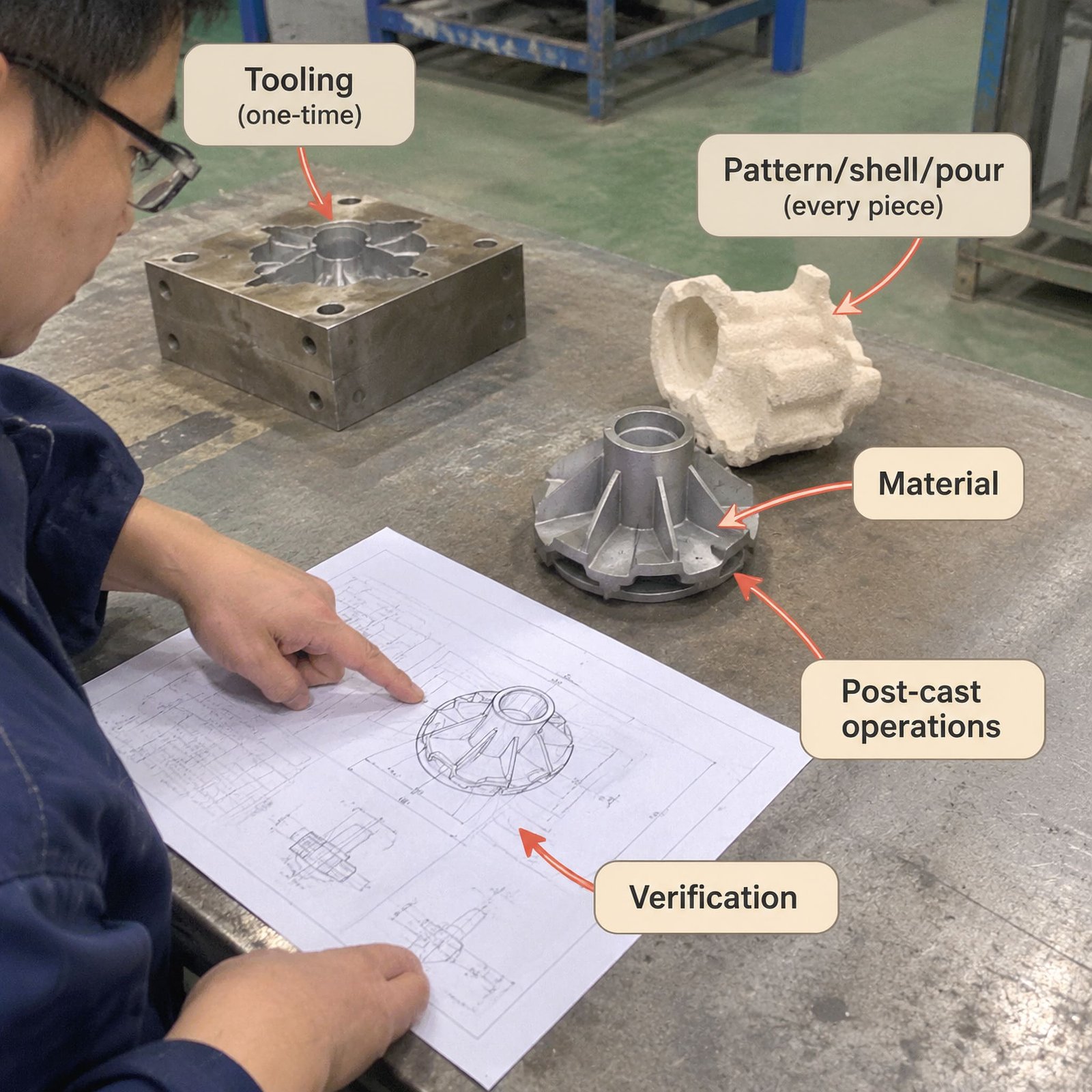
Our process overview states that the piece price is driven by weight, material, complexity and required finishing or machining. The pricing guide adds that geometry, tooling, quantity, machining, finishing and verification all change the offer. Price does not scale simply with finished weight.
Design features that move the unit price
Most of the recurring cost is set when the drawing is released. These are the features worth reviewing before you send an RFQ.
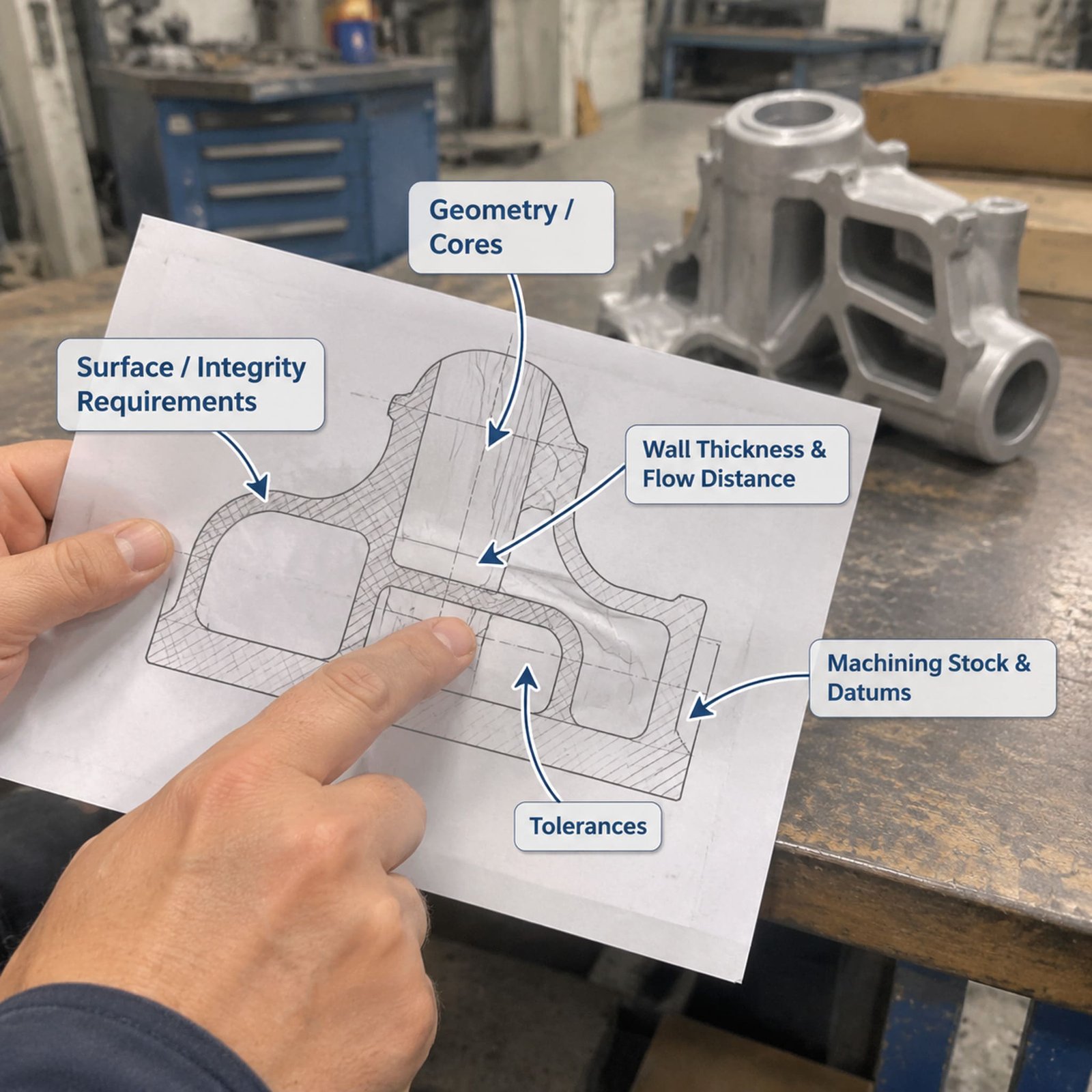
Geometry and cores
Internal passages, undercuts and integrated features are a main reason to choose investment casting. They also need cores or split tooling, plus cleaning access and inspection access. A passage that cannot be cleaned or checked easily adds handling time and risk to every piece. Ask the supplier which features drive its proposed route, rather than assuming complexity costs nothing once the tool exists.
Wall thickness and flow distance
Thin areas far from the gate are hard to fill. When a section risks misrun or incomplete filling, the foundry may need more conservative gating, slower handling or extra inspection. If yield losses rise, you pay for scrapped castings in the piece price.
Our wall thickness guide explains why there is no single minimum wall value. Flow path, adjoining sections and alloy all matter. The thin-wall defect guide covers how these problems appear. The cost lesson is that a targeted change to a hard-to-fill feature is often more useful than thickening the whole part. Added mass also changes feeding, cooling, weight and machining.
Tolerances
This is where over-specification is most common. A tight general tolerance applied to the whole drawing forces the supplier to price for the hardest feature everywhere. That can mean extra tooling compensation, extra machining or more measurement.
Our ISO 8062 tolerance article makes two points:
- A grade number alone does not confirm every feature is achievable.
- Applying unnecessarily tight requirements to non-critical features can change tooling, processing and inspection without improving the assembly.
Keep tight control on the features that seal, locate or carry load. Let the rest follow a general requirement that suits their function.
Machining stock and datums
Investment casting is near-net shape, not no-machining shape. Sealing faces, bores, threads and mating surfaces often still need finishing. The cost question is how many features need machining, how many setups that takes, and whether the casting gives a reliable way to locate the part.
If datums are not planned with the casting, the machinist may need extra setups or custom fixtures. The pump and valve investment casting guide makes the same point: the blank must leave usable stock at the interfaces, and machining must relate those interfaces to the functional datums.
Surface and integrity requirements
A cosmetic exterior and a sealing surface do not need the same specification. Define roughness, appearance and internal soundness only where the part needs them. A blanket requirement for a defect-free surface or full radiography multiplies inspection cost. The defect acceptance guide explains how to set acceptance criteria by location and function.
Volume and tooling amortization
The one-time tooling charge is spread over every part you buy from that tool. At low volume, tooling is a large share of the effective cost per part. As volume grows, that share shrinks, and the recurring piece price dominates.
This is why the quantity basis matters. Our process overview describes investment casting tooling as relatively low in cost. It describes the process as economical from hundreds to tens of thousands of parts. Hardened die casting dies cost more but are built for very long runs. These are Tianlu's general statements, not a break-even quantity for your part.
Keep three quantities separate in the RFQ:
- Sample quantity. What you need for first article and functional evaluation.
- Batch size. How many parts you release per order. Setup, melting and inspection overheads are shared across each batch, so very small, frequent releases can raise the piece price.
- Annual forecast. What the program expects over a year, with an honest indication of how firm that forecast is.
Also consider design stability. If the drawing is likely to change after tooling, a modification or a new sampling round can change the economics. Ask how tool changes, maintenance and replacement are handled. The aluminum investment casting vs die casting comparison covers this risk in detail.
How investment casting compares with sand casting, die casting and machining on cost
No process is cheapest for every part. Treat the following as starting points for the comparison, not verdicts.
- Die casting uses reusable metal dies. These cost more up front but can make sense for high-volume non-ferrous parts, mainly aluminum and zinc. It is generally not an option for steels and other high-melting-point alloys. For a steel part, the realistic comparison is usually investment casting against sand casting, forging or machining. See investment casting vs die casting. Even for aluminum, Tianlu's published comparison notes that volume alone does not settle the question. Tooling, design stability, finishing and inspection all affect the result.
- Sand casting is described in Tianlu's energy equipment guide as generally more economical for very large, simple parts where surface finish is not a primary concern. For smaller, more detailed parts, investment casting may reduce machining. That is only true if the as-cast features actually meet the drawing. Compare full finished-part quotes rather than assuming either way.
- Machining from solid has no tooling charge, which suits prototypes and very low volumes. On complex shapes, cycle time and material removal keep the per-piece cost high as volume grows. A common middle route is to cast the complex geometry and machine only the critical features.
Whatever routes you compare, use the same drawing revision, material requirement and acceptance scope for each. Otherwise a lower blank price can look like a lower cost for the accepted part when it is not.
DFM moves that usually reduce cost
These changes are worth discussing with the casting engineer before tooling is released. Each one is a trade-off, so check it against fit, function, load paths, flow area and appearance before accepting it.
- Fix the hard-to-fill features locally. If one rib or thin web is driving misrun risk, adjust that feature rather than the whole part.
- Tier your tolerances. Keep tight individual tolerances on sealing, locating and load-bearing features. Use a general requirement suited to function everywhere else.
- Machine only where function requires it. Replace full-face machining with local machining at gasket contacts, bearing seats and mating pads where the design allows.
- Plan datums with the casting. Agree locating surfaces that exist on the as-cast part and remain available through machining. This can reduce setups and fixture complexity.
- Match inspection to risk. Inspect critical features at a frequency suited to the risk, and agree in writing which checks are 100% and which are sampled.
- Consider consolidating parts. If an assembly of welded or bolted pieces could become one casting, review whether that removes joining and assembly steps. Confirm it does not complicate machining or inspection.
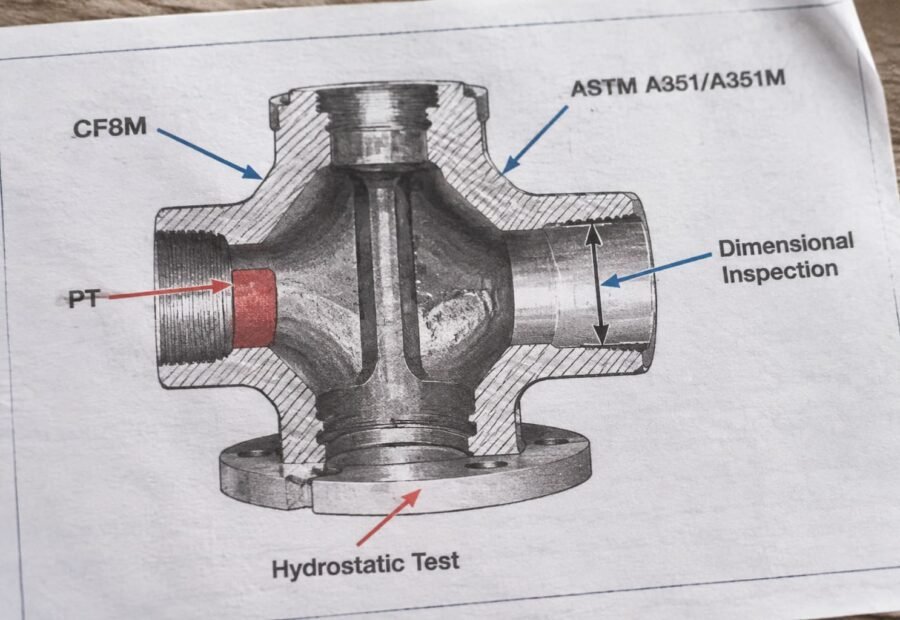
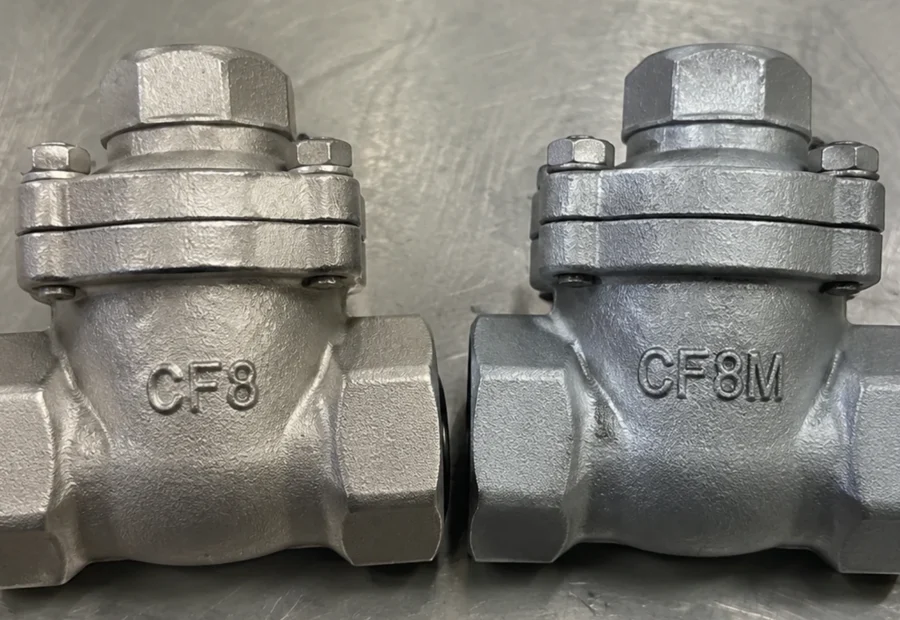
- Specify material precisely. A grade with its standard and condition prevents suppliers from pricing different materials. Do not treat a wrought designation as a casting grade. For example, CF8M castings are not unconditionally interchangeable with wrought 316. Our carbon steel investment casting guide explains why the standard matters.
If a supplier proposes a DFM change, ask for a marked drawing and a written explanation tied to the drawing revision. An informal suggestion should not silently become the production definition.
Illustrative scenario: where the cost really sits on a small CF8M flow part
The following is a hypothetical engineering scenario, written to show how the cost drivers interact. It is not a description of a specific customer order, and it does not quote actual prices or results.
Imagine a small CF8M flow splitter for a fluid-control assembly, ordered in steady annual volumes. The first drawing has these features:
- A uniform wall thickness across all flow ribs, including thin internal ribs far from any practical gate location.
- A very tight casting tolerance grade on two outer parallel faces.
- Full-face milling on both outer faces.
- 100% dimensional inspection of those faces.
A casting engineer reviewing this drawing would likely identify three cost drivers.
- The internal ribs are the misrun risk. To fill them reliably at the original thickness, the foundry may choose more conservative gating and accept higher yield loss. Both appear in the piece price.
- The outer faces are not the sealing feature. The only sealing-critical surface is the internal seat. Yet the outer faces carry the tightest requirement on the drawing, plus full machining and full inspection.
- Full-face milling adds machining time to every part, though only the gasket contact area actually needs a controlled surface.
A DFM revision could address all three:
- Thicken only the hard-to-fill internal ribs, leaving the outer functional walls unchanged.
- Keep the tight tolerance on the sealing seat and move the outer faces to a general grade suited to their function.
- Replace full-face milling with local machining at the gasket contact.
If the existing tool can accept the rib change through a minor insert adjustment, no new hard tool is needed.
The expected effects follow directly from the cost structure. Fewer scrapped castings should lower the casting cost. Less machining time and one fewer 100% gauge check reduce the recurring operations. The sealing function is still controlled where it matters. The actual savings for any real part can only be confirmed by quoting both revisions against the same delivered scope.
What to put in your RFQ so the quote reflects real cost
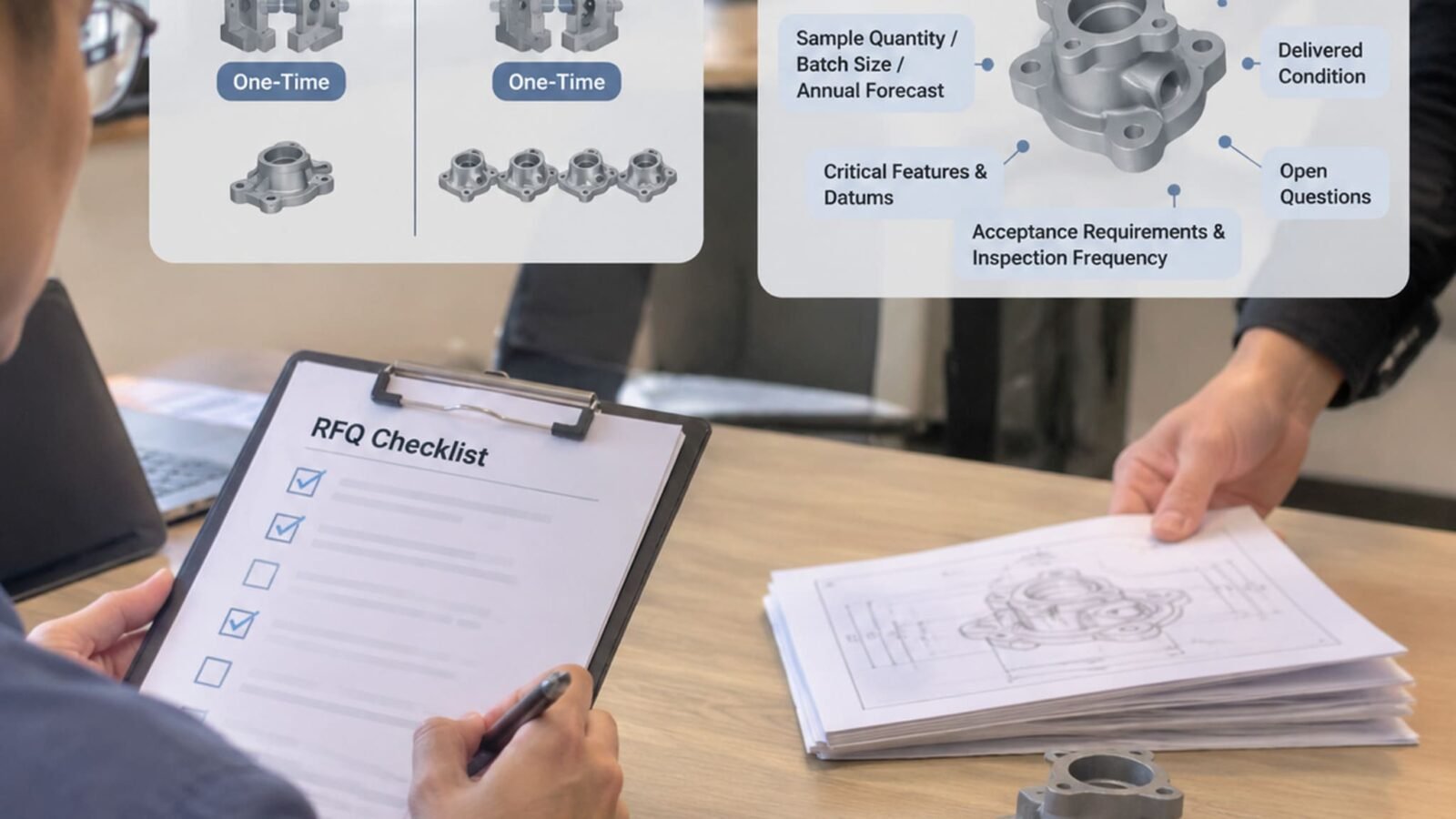
A supplier can only price what it can see. A vague RFQ either gets a conservative price that covers unknowns, or a low price that leaves out work you need. Our RFQ checklist gives a full working template. For cost accuracy, these items matter most:
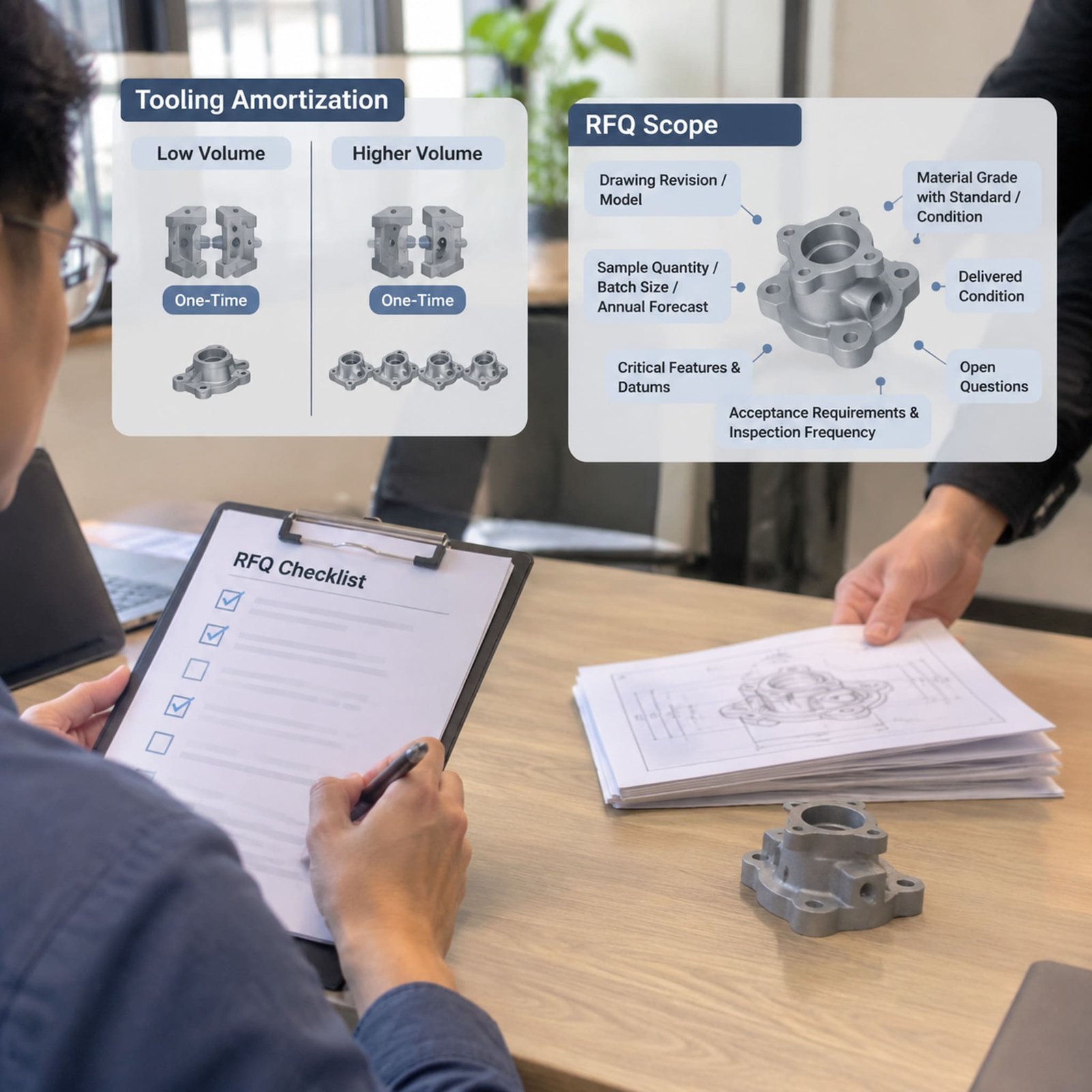
- A controlled 2D drawing and 3D model, with the revision identified and the governing document agreed.
- Material grade with standard and condition, or the service environment if the grade is still open.
- Sample quantity, batch size and annual forecast, listed separately.
- Delivered condition: as-cast, partly machined or finished, and which operations are included.
- Critical features and datums: which features seal, locate or carry load, and which surfaces must be machined.
- Acceptance requirements: dimensional checks, material records, NDT or leak testing, and the inspection frequency.
- Open questions, marked as open, so the supplier can explain how each one affects feasibility or price.
It also helps to ask the supplier directly which features drive its price, and what one or two drawing changes would have the biggest effect. That question often turns a quotation into a useful DFM conversation.
Frequently asked questions
Is investment casting expensive?
It depends on the comparison. Tooling is generally simpler than a die casting die. Each piece needs its own pattern and shell, and many parts still need machining at the interfaces. For complex steel or stainless parts at moderate volumes, it can be a sensible route. Confirm that with quotes for your actual part.
Can I get a price from a photo or weight alone?
A photo or sample can start a discussion. It cannot define tolerances, internal requirements or acceptance, which are the items that most often change the price.
Why do quotes for the same part vary so much?
Usually because suppliers assumed different scopes. One may quote a raw blank and another a machined, inspected part. Another may have assumed a different material standard or inspection level. Compare offers only after you line up what each one includes.
Next step
The Tianlu investment casting capability page describes our process route and quality planning. It also includes a documented 304 stainless exhaust manifold project, where drawing and DFM review came before sampling, material and dimensional checks, and interface finishing.