Mobility

Automotive & Mobility Cast Components

This page covers custom cast and machined metal parts for automotive and mobility equipment: water pump housings, exhaust manifolds, machined assembly interfaces and the drawing details reviewed before quoting.

Speak to an Engineer ›
Automotive & Mobility Cast Components application reference

From operating duty to component detail

Automotive cast component requirements

Connect the service conditions and installed assembly to the features that need casting, machining, surface treatment and inspection.

Operating duty and service environment

Describe the component in its installed assembly, including vibration, repeated loads, temperatures and contact with operating fluids. For engine parts, identify the cooling or exhaust duty. For marine hardware, specify water exposure, the mating structure and the required visible finish.

Datums, sealing and assembly access

Identify the bearing or shaft seats, flange registers, gasket faces, ports and mounting holes that locate the part. Define their relationship to common datums, the mating-component dimensions and access for tools, fasteners and service replacement.

Post-cast machining and datum control

Separate as-cast surfaces from machined interfaces in the drawing. Define the datum scheme, sealing faces, bores and mounting faces that control assembly, plus the stock allowance needed before machining. The linked turbo manifold case records drawing review of passage continuity, wall transitions and distortion control, with flange interfaces and mounting locations integrated in the casting. Confirm which dimensions are checked after machining and who approves the fixture or first sample.

Alloy and manufacturing sequence

Provide the material grade, supply condition, wall transitions and internal passages with the expected quantity. Related projects use A356.2 gravity casting with T6 treatment and 304 stainless investment casting. Review casting, heat treatment, machining and finishing as one component-specific route.

Inspection and repeat supply

Mark critical dimensions and specify applicable pressure, leak, movement or load checks with their test conditions. Agree the sample approval criteria, material and dimensional records, drawing revision, batch identification and packing requirements before production release.

Define the supplied scope

Specify a casting blank, machined component or finished part, including any inserts, bushes, seals or fasteners supplied with it. Share the drawing revision, alloy, batch quantities and records required for first-sample approval and repeat deliveries.

RFQ checklist for automotive cast components

  • Drawing revision and 3D model, including any pending changes
  • Alloy and heat-treatment condition
  • Casting process, or the interfaces where you want a process recommendation
  • Datums, sealing faces and machined assembly interfaces
  • Pressure, leak, dimensional or NDE checks required for approval
  • Annual volume, launch quantity and repeat schedule
  • Documentation and traceability requirements

Explore the assembly

Components in Focus

Explore how the components fit together. Illustrative assembly.

Automotive & Mobility — illustrative assembly

Twin-lobe cover with two machined bearing openings.

Component information
  1. Front drive coverTwin-lobe cover with two machined bearing openings.
  2. Transmission gear cartridgeThree toothed wheels with separate hubs and an intermediate shaft.
  3. Twin-axis drive housingOpen twin-axis housing with external cooling ribs.
  4. Input rotor and shaftBanded rotor, through shaft and bearing rings.
  5. Output shaft assemblyStepped shaft with a cylindrical drum, bearing rings and splined ends.
  6. Rear drive coverRemovable rear plate with shaft openings.
  7. Top junction coverCompact top cap with cable-entry collars.
Documented examples and interfaces to specify
Documented exampleProcess / material in linked caseWhat to specify
Water pump housingsLinked A356 water pump housing caseMounting datums, sealing face, functional test requirements
Turbo exhaust manifold304 stainless investment castingPassage continuity, flange interfaces, distortion control
Marine & boat hardware castingsCF8 or CF8M investment casting examplesAlloy or corrosion class, attachment loads

Explore by component

Product Applications for Automotive & Mobility

Component examples

Engine cooling housings and exhaust components

Two projects show different manufacturing priorities: pressure-boundary and assembly control for a water pump housing, and integrated passages and finished interfaces for an exhaust manifold.

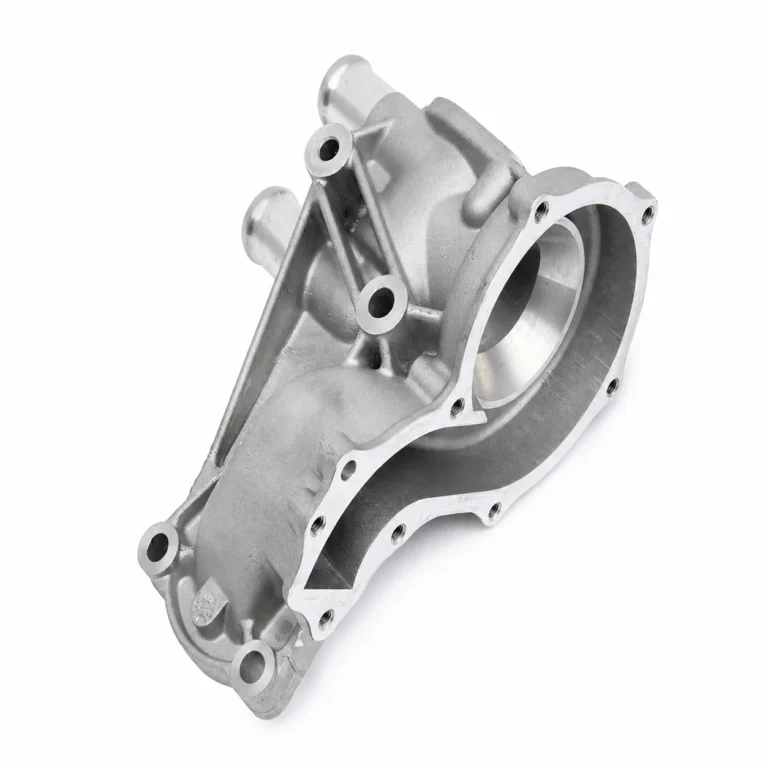
Water pump housing casting with broad flange, curved passage and two pipe connections

A356.2 · Gravity casting + T6

Heavy-vehicle water pump housing

Casting and machining
The project used a metal mold, gravity pouring and T6 treatment. Revised vent grooves and pouring speed addressed gas entrapment in the curved passage; CNC work finished the register, bearing bore, water connections and bolt holes.
Drawing requirements
The project specified flange-register roundness no greater than 0.04 mm and hole-position control of ±0.05 mm. These requirements relate to the pump housing interfaces after machining.
Recorded checks and result
The project record reports no leakage under a 0.35 MPa water-pressure test. It also reports that the nonconforming rate fell to 1.2% after the venting and pouring adjustments, followed by stable supply.
Read the component case
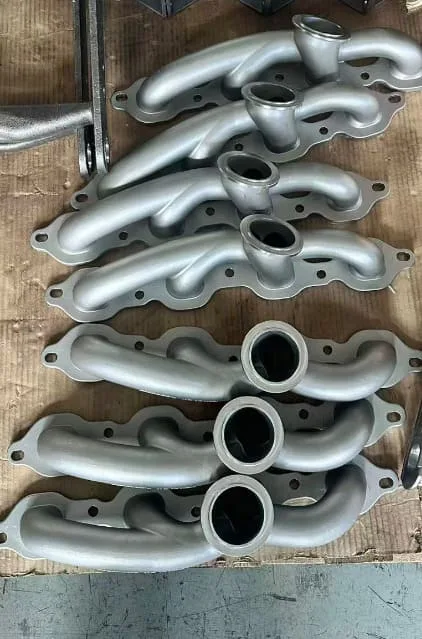
Finished 304 stainless investment-cast turbo exhaust manifolds arranged as a batch

304 stainless steel · Investment casting

Turbo exhaust manifold

Integrated geometry
Curved exhaust passages, flange interfaces and mounting locations are combined in one casting for a performance turbocharger exhaust system. The project specified 304 stainless steel for its application.
Manufacturing review
Drawing review covered passage continuity, wall transitions, wax and shell handling, filling and feeding, distortion control and finishing access. Blasting provided the specified external surface condition.
Inspection and acceptance
The recorded checks covered material identity, flange and mounting dimensions, visual inspection and customer installation testing. The customer accepted the component within the project validation scope and continued repeat ordering.
Read the component case

For another engine-cooling route, see the A356 low-pressure cast water pump housing. Connect the component drawing to tooling, sample approval and production release.

Marine hardware examples: stainless steel crossbar mooring cleats, CF8 curved hook mounts and CF8M compact mooring cleat. Review their mounting, contact and finish requirements through the Marine & Boat Hardware application above.

Connected manufacturing

Related Capabilities & Materials

Explore the processes and material families connected to this application.

Process fit at a glance

Start with the feature that controls the part: internal passage geometry, wall thickness, alloy, volume and machining allowance.

Investment casting

Often reviewed for complex internal passages and alloy flexibility.

Die casting

Reviewed for high-volume thin-wall parts.

Sand casting

Reviewed for larger housings.

For a side-by-side comparison, read our existing investment casting vs die casting article.

Engineering support

Review your component in its assembly

Share the drawing, mating-part details, alloy and quantities. Include operating temperatures, fluids, loads, surface finish and the dimensional or functional records required for sample approval.

Discuss Your Part

Project inquiry

Discuss your application

Share your requirements for an engineering review.