What Makes 17-4 PH Stainless Steel Investment Casting So Demanding?
Struggling to find a material that offers both high strength and excellent corrosion resistance for a complex part? You've identified 17-4 PH stainless steel, but now the real challenge begins: turning that material specification into a reliable, functional component. Simply writing "17-4 PH" on a drawing is a common starting point, but it often leads to inaccurate quotes, production delays, and parts that fail to perform. A successful 17-4 PH stainless steel investment casting project requires a much deeper conversation about heat treatment, machining allowances, and final inspection requirements.
This article explains the critical details needed for manufacturing a 17-4 PH stainless steel investment casting. Success depends on specifying the final heat treatment condition (such as H900, H1025, or H1150), as this step determines the part's final mechanical properties, including hardness, tensile strength, and corrosion resistance. Without this information, a manufacturer cannot confirm feasibility or provide a reliable quotation.
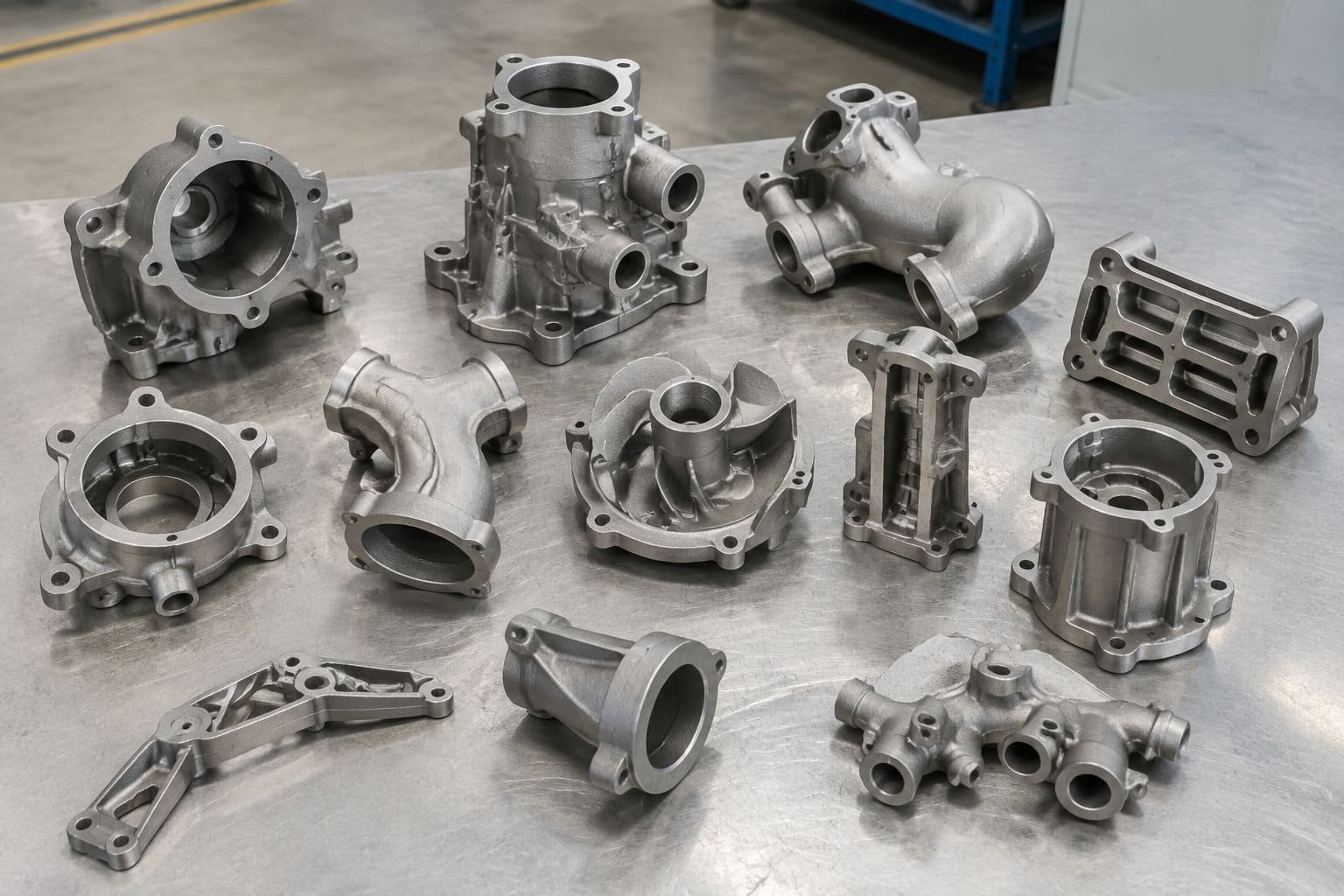
Getting this right isn't just about chemistry; it's about manufacturing intent. Let's break down the key questions we, as a manufacturer, ask to navigate the complexities of this versatile alloy and ensure the parts you receive match the performance you designed.
Why is the Heat Treatment Condition So Critical for 17-4 PH Investment Casting?
You’ve specified 17-4 PH on your drawing, expecting a specific level of performance. But without a defined heat treatment condition, that material callout is incomplete. We might see a note for "17-4 PH," but we have no way of knowing if you need the highest strength, maximum toughness, or a balanced profile. This ambiguity forces us to guess, which is something no good supplier should do.
The heat treatment condition is critical because it dictates the final mechanical properties of the part. 17-4 PH is a precipitation-hardening (PH) martensitic stainless steel.[1] This means it can be heat-treated to a wide range of strength and toughness levels after being cast, making it incredibly versatile but also demanding clear instructions.
What Are Common Heat Treatment Conditions?
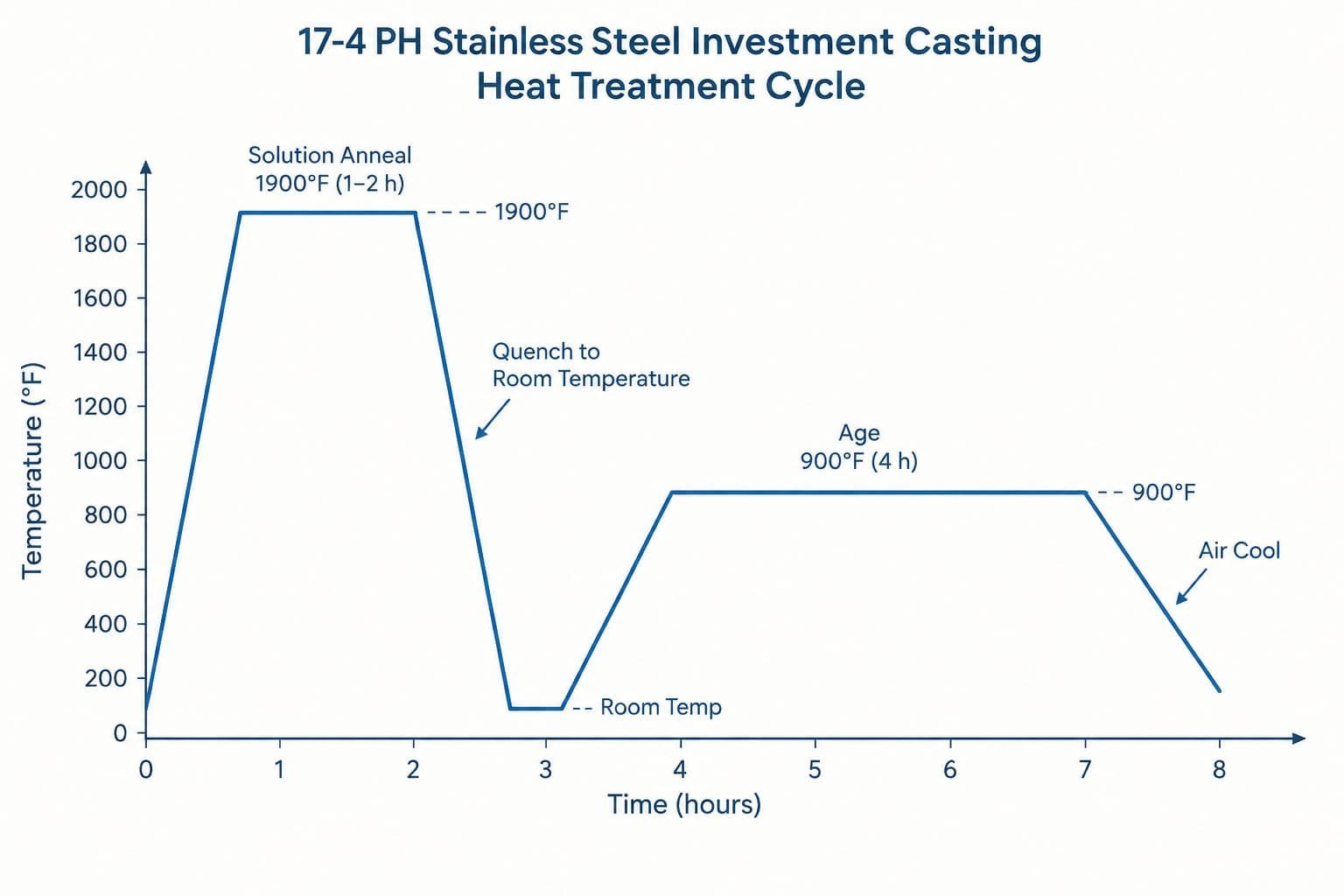
The raw casting is first produced in a solution-annealed state, known as Condition A. This is a relatively soft, ductile state ideal for any preliminary machining. After casting, the part is aged at a specific temperature for a set duration to achieve the desired properties.
The "H" designation refers to the aging temperature in degrees Fahrenheit.[2] For instance, H900 means aging at 900°F. Here’s a quick breakdown of how this choice impacts the final part:
| Condition | Aging Temp. | Resulting Properties | Common Applications |
|---|---|---|---|
| H900 | 900°F (482°C) | Highest strength, highest hardness, good toughness.[3] | High-stress components, structural parts, shafts. |
| H1025 | 1025°F (552°C) | Good balance of strength, toughness, and stress corrosion cracking resistance. | Valve parts, pump components, aerospace fittings. |
| H1150 | 1150°F (621°C) | Maximum toughness and ductility, lower strength.[4] | Parts subject to impact loads or high vibration. |
When we receive an RFQ without a specified condition, the first question we ask is, "What hardness or tensile strength are you trying to achieve?" This helps us recommend the right heat treatment cycle.
How This Affects the Manufacturing Process
The manufacturing route is almost always the same:
- Cast: The part is investment cast in Condition A.
- Machine (Optional): If heavy machining is needed, some operations may be performed while the material is still soft.
- Heat Treat: The part is aged to the specified condition (e.g., H900, H1150).
- Final Machine: Critical tolerances and surfaces are machined after heat treatment to account for any minor distortion that may occur.
- Inspect: Final dimensions, hardness, and other requirements are verified.
Understanding this flow is crucial. Attempting to machine all features before heat treatment is risky, as the process can cause slight changes in dimensions[5]. For this reason, we plan for finishing operations after the part has achieved its final, stable properties.
How Do We Evaluate if Your Part is Suitable for 17-4 PH Stainless Steel Investment Casting?
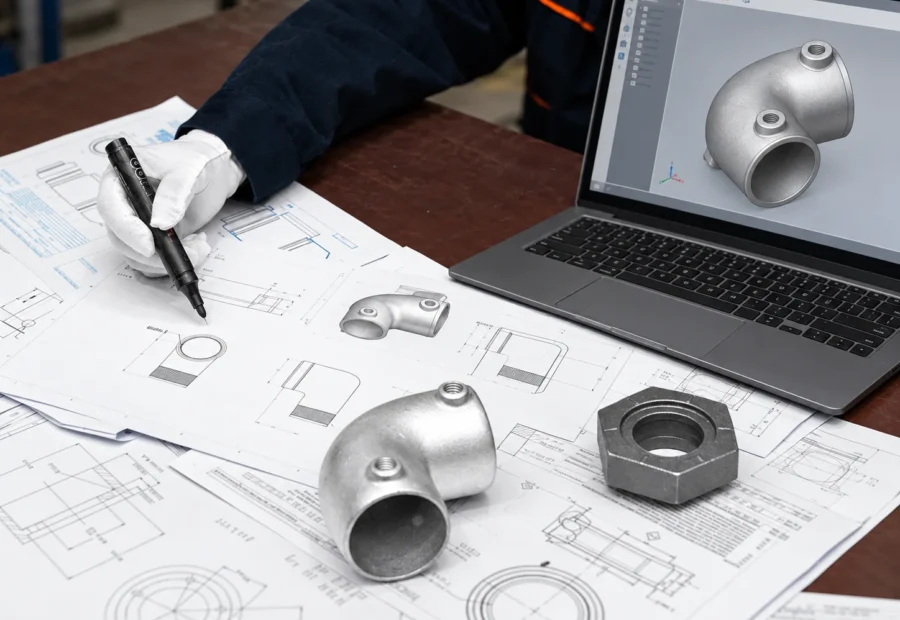
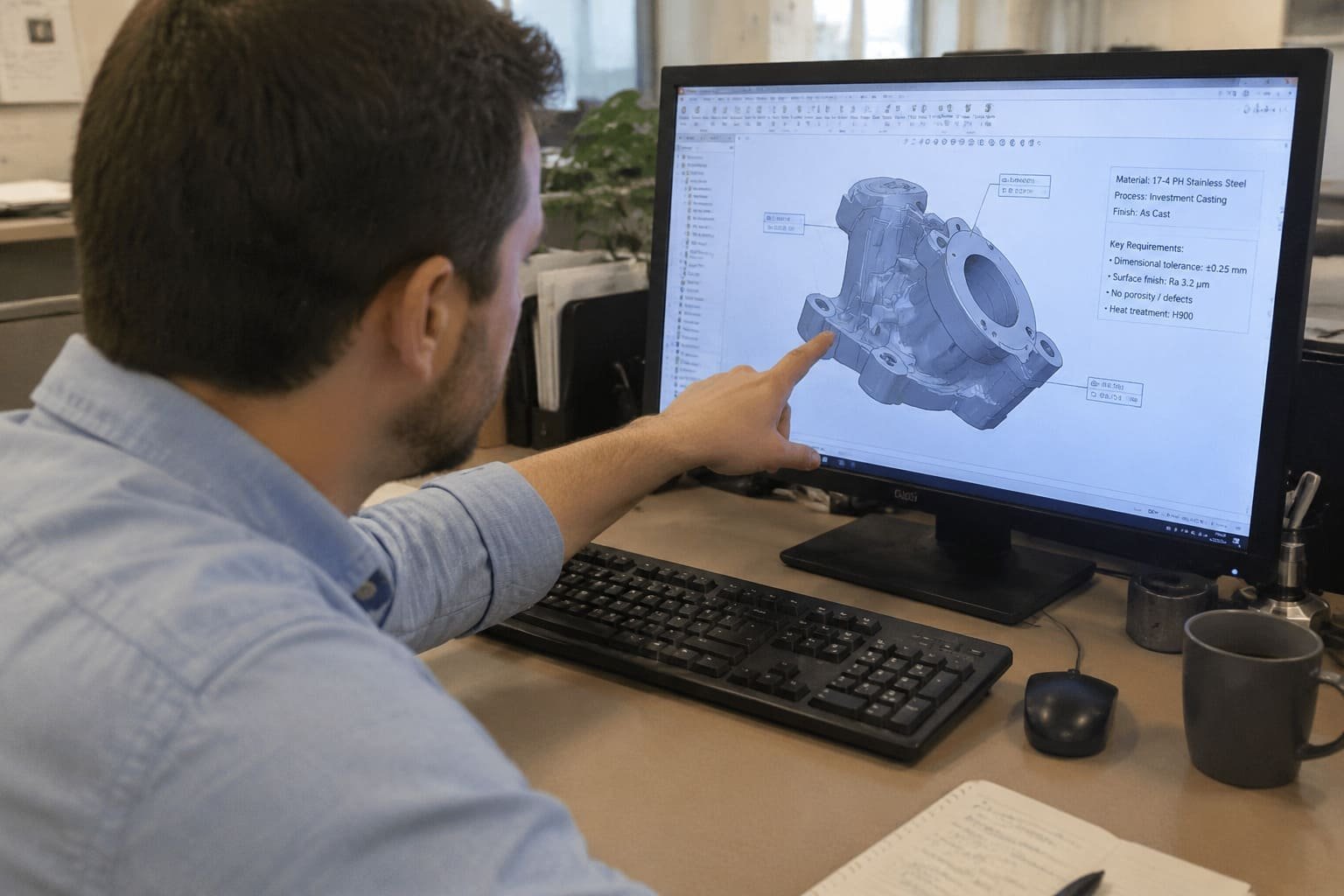
You have a 3D model of a part you believe is a good candidate for this process. But a picture or a simple weight estimate isn't enough to confirm feasibility. We frequently receive inquiries with just a photo, but to provide a responsible quote for 17-4 PH stainless steel investment casting, we must analyze the complete engineering drawing and 3D model.
We evaluate the full geometry to identify potential manufacturing risks and define a clear production path. This review isn't about finding fault in the design; it's about proactively solving casting challenges before a mold is ever made, saving time and money.
Key Geometric Features We Analyze
When your design lands on our desk, our engineers immediately look for specific features that influence the success of the casting process. These include:
- Wall Thickness: Are there sections that are too thin to fill properly with molten metal? Conversely, are there overly thick sections that could lead to shrinkage porosity? Uniform wall thickness is ideal.[6]
- Fillets and Radii: Sharp internal corners are points of high stress and can cause cracking during cooling or heat treatment. We look for generous fillets to ensure smooth metal flow and structural integrity.
- Draft Angles: While investment casting is known for its ability to produce complex shapes with near-net-zero draft, small draft angles can still aid in releasing the wax pattern from the initial injection mold.[7]
- Holes and Passages: We assess if holes can be cast-in or if they are better drilled during a secondary machining operation. The L/D (length-to-diameter) ratio is a key factor here.
From Drawing to Production Plan
A complete technical package allows us to build a comprehensive production plan. An ideal RFQ for a 17-4 PH stainless steel investment casting includes:
- A 3D model (STEP or IGS format is great).
- A 2D drawing with all critical dimensions, tolerances, and surface finish callouts.
- Material specification, including the heat treatment condition (e.g., "17-4 PH, H1025").
- Testing and inspection requirements (e.g., hardness testing, material certificates, dimensional inspection reports).
- Estimated annual usage (EAU) to determine mold cavitation and pricing strategy.
With this information, we can separate features that can be achieved "as-cast" from those that require post-casting machining. This detailed review is the foundation of a reliable and competitive quote.
What's the Difference Between As-Cast and Finished Part Requirements?
A common misconception is that investment casting produces a perfectly finished part straight from the mold. This can lead to frustration when as-cast parts don't meet the tight tolerances specified on a drawing. It's vital to distinguish between what the casting process can deliver and what the final, functional part requires.
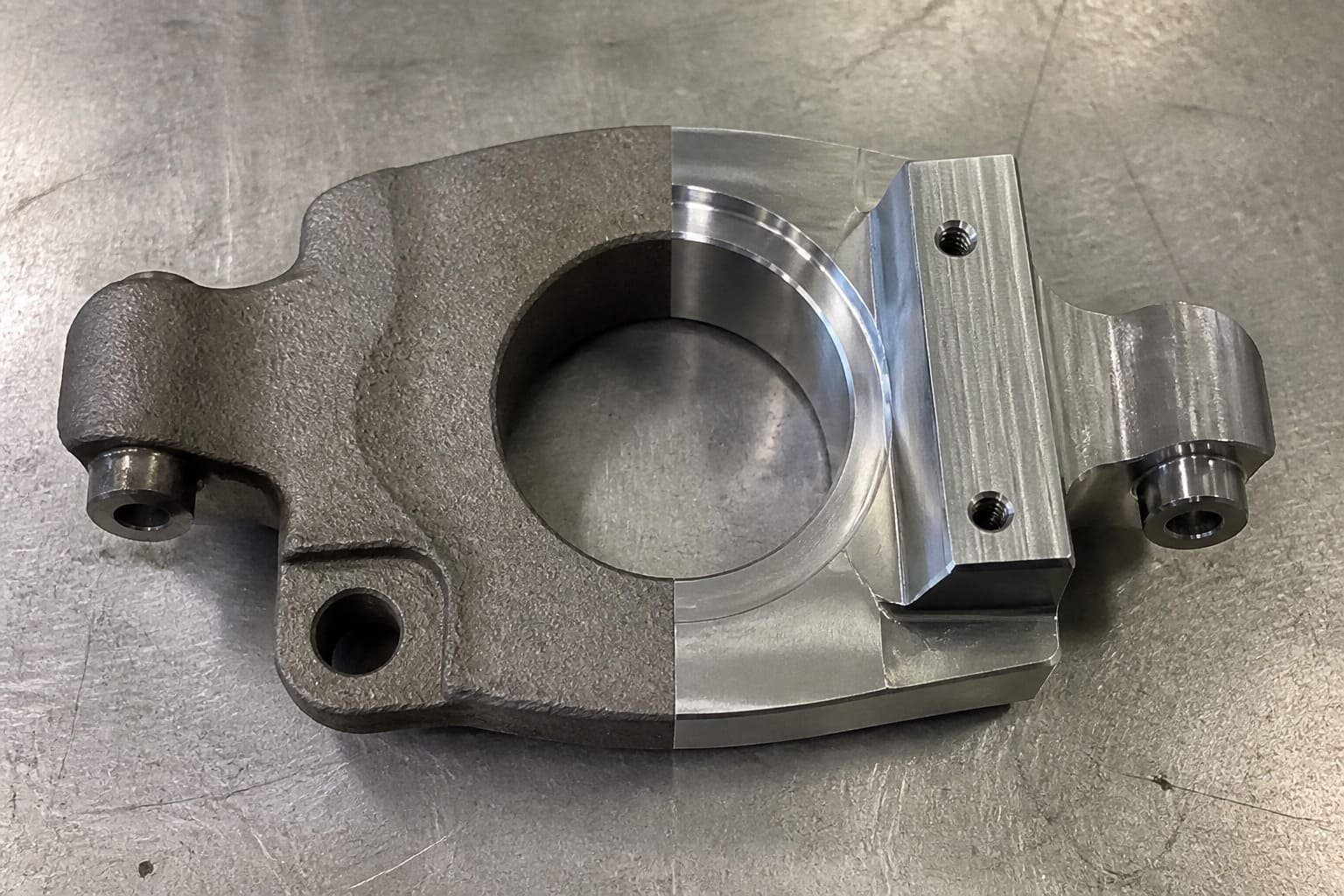
The "as-cast" part is the component directly after the casting and finishing processes (like gate grinding and sandblasting). A "finished" part is one that has undergone all necessary secondary operations, such as CNC machining, to meet all drawing specifications.
Typical As-Cast Tolerances
Investment casting is a precise process, but it's not magic. Like any manufacturing method involving molten metal and solidification, it has inherent dimensional variations. As-cast tolerances are typically governed by standards like ISO 8062.[8] For many dimensions, we can hold ±0.1mm to ±0.5mm, depending on the size and complexity of the feature.[9]
Surface finish is another key as-cast characteristic. A typical investment casting might have a surface roughness of Ra 3.2 to 6.3 µm (125 to 250 µin).[10] This is excellent for many industrial applications, but if your part requires a smoother finish for sealing or aesthetic reasons, it will need polishing or machining.
When is Post-Casting Machining Required?
We always plan for machining when a drawing specifies features that exceed standard as-cast capabilities. This includes:
- Tight Tolerances: Any dimensional tolerance tighter than what the casting process can consistently hold.
- Critical Diameters and Bores: Features that need to mate with bearings, shafts, or other components.
- Flatness and Parallelism: Large, flat surfaces that need to be perfectly sealed or mounted.
- Threaded Holes: Threads are almost always created in a secondary drilling and tapping operation.
- Specific Surface Finishes: Any surface requiring a finish smoother than Ra 3.2 µm.
Planning Machining Allowances
To accommodate this, we strategically add extra material—a "machining allowance" or "machining stock"—to specific surfaces of the casting model. For example, if a drawing calls for a 25.0 mm finished bore, we might cast it at 24.0 mm. This leaves 0.5 mm of material on all sides for a CNC machine to remove, ensuring the final bore is perfectly sized, located, and finished. This proactive planning is a core part of our process engineering for every 17-4 PH stainless steel investment casting project.
When Should You Choose 17-4 PH Over Other Stainless Steels?
With so many grades of stainless steel available, why choose 17-4 PH? It's easy to fall into the trap of thinking it's universally "better" than 304 or 316. The reality is that material selection is always a trade-off based on the specific demands of your application.
Choose 17-4 PH when you need a unique combination of properties that other alloys cannot provide in a single package. It shines in applications requiring the high strength of an alloy steel combined with the superior corrosion resistance of a stainless steel.
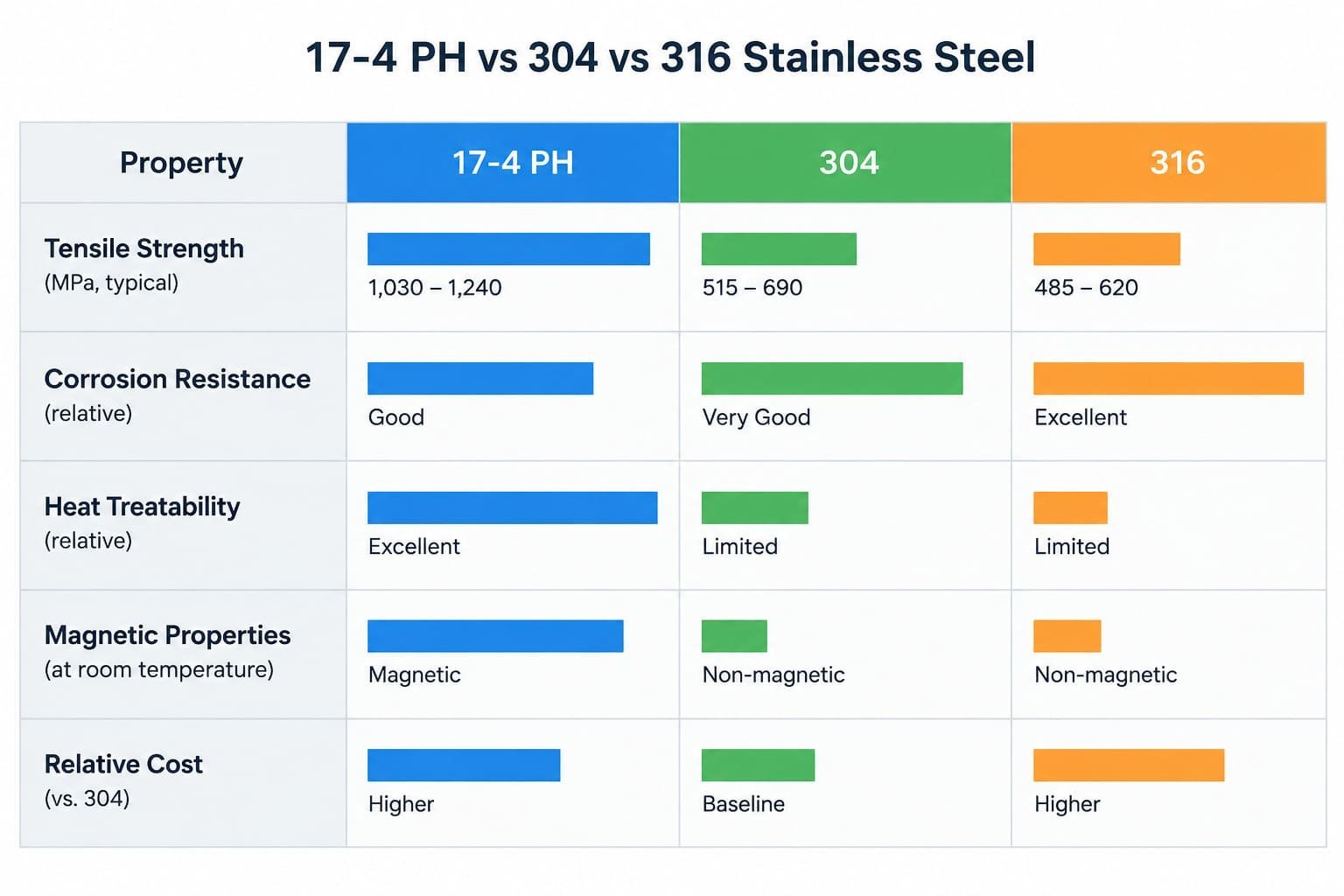
A Practical Comparison
Let’s compare 17-4 PH (in the common H1025 condition) to the two most common austenitic stainless steels, 304 and 316.
| Property | 17-4 PH (H1025) | 304 Stainless Steel (Annealed) | 316 Stainless Steel (Annealed) |
|---|---|---|---|
| Tensile Strength | Very High (approx. 1000-1170 MPa) | Medium (approx. 515 MPa) | Medium (approx. 515 MPa)[11] |
| Corrosion Resistance | Good. Generally better than 400-series, slightly less than 316. | Good general-purpose resistance. | Excellent, especially against chlorides. |
| Heat Treatable? | Yes, for high strength. | No (can only be hardened by cold work). | No (can only be hardened by cold work). |
| Magnetic? | Yes. | No (in annealed state). | No (in annealed state). |
| Relative Cost | Higher | Lower | Moderate |
This table makes the choice clearer:
- If your primary need is maximum strength and hardness in a corrosive environment, 17-4 PH stainless steel investment casting is an excellent choice.
- If your part needs good general corrosion resistance at a lower cost and doesn't face high mechanical stress, 304 is often sufficient.
- If the part will be exposed to saltwater, de-icing salts, or other chloride-rich environments, the superior corrosion resistance of 316 is likely the best option.[12]
The decision should never be based on strength alone. It’s a balance of performance, manufacturability, and cost, all driven by the real-world conditions your component will face.
Frequently Asked Questions
What is the typical surface finish for 17-4 PH investment casting?
The as-cast surface finish for 17-4 PH investment castings is typically in the range of Ra 3.2 to 6.3 micrometers (125-250 microinches). This can be improved through secondary operations like grinding, polishing, or electropolishing if a smoother surface is required for sealing or cosmetic purposes.
Can 17-4 PH investment castings be welded?
Yes, 17-4 PH is generally considered weldable. For best results, welding is often performed when the material is in the solution-annealed (Condition A) state, followed by a full heat treatment cycle for the entire assembly. Welding on an already age-hardened part requires careful procedures to manage the heat-affected zone.
What is the minimum wall thickness you can cast with this alloy?
The minimum achievable wall thickness depends heavily on the part's overall size, geometry, and metal flow distance. As a general guideline, 2-3 mm (0.080-0.120 inches) is a safe starting point for most designs. Thinner sections may be possible in localized areas but should be discussed during a design for manufacturability (DFM) review.
How much does tooling for a 17-4 PH casting cost?
Tooling (the mold used to create wax patterns) cost varies significantly based on part size, complexity, and the number of cavities. A simple, small part might have tooling that costs a few thousand dollars, while a large, complex part with slides or cores could cost ten thousand dollars or more.
Conclusion
A successful 17-4 PH stainless steel investment casting project is about clear communication and detailed planning. It moves beyond a simple material callout to a complete manufacturing strategy. The key takeaways are to always specify the required heat treatment condition, provide complete 2D and 3D files for a thorough design review, distinguish between as-cast capabilities and finished part requirements, and choose your material based on a balanced assessment of your application's true needs. This collaborative approach ensures that the final component performs exactly as intended.
If you are developing a component and considering 17-4 PH, our team is ready to help. Send us your drawings or 3D models through our inquiry form, and let's work together to determine the most effective and reliable manufacturing path for your project.
Sources & references
Reference note
17-4 PH (UNS S17400) is commonly classified as a precipitation-hardening martensitic stainless steel whose strength is developed through heat treatment. Evidence role: definition; source type: government. Supports: The source should identify UNS S17400/17-4 PH as a precipitation-hardening martensitic stainless steel..
Reference note
Published heat-treatment schedules for 17-4 PH use H-condition designations corresponding to the nominal precipitation-aging temperature in degrees Fahrenheit. Evidence role: definition; source type: institution. Supports: The source should document that H900, H1025, and H1150 designate aging treatments at approximately 900 °F, 1025 °F, and 1150 °F, respectively..
Reference note
Standard property tables for 17-4 PH show that the H900 aging condition generally provides higher strength and hardness than the higher-temperature H1025 and H1150 conditions. Evidence role: statistic; source type: paper. Supports: The source should provide mechanical-property data showing that H900 generally has higher specified tensile strength and hardness than H1025 and H1150.. Scope note: Actual values depend on product form, chemistry, section size, heat-treatment practice, and the governing specification.
Reference note
For 17-4 PH, higher-temperature aging treatments such as H1150 are generally associated with reduced strength and improved ductility and toughness relative to lower-temperature aging conditions. Evidence role: mechanism; source type: research. Supports: The source should explain or document the trade-off in 17-4 PH between higher aging temperature and the resulting strength, ductility, and toughness.. Scope note: The term “maximum” should be interpreted only among the conditions compared and not as a universal guarantee for every toughness metric or product form.
Reference note
Thermal cycles and microstructural transformations during heat treatment can produce dimensional change or distortion, so final machining is often reserved for critical features. Evidence role: mechanism; source type: paper. Supports: The source should document dimensional change or distortion associated with thermal treatment and phase transformation in 17-4 PH or comparable precipitation-hardening stainless steels.. Scope note: The magnitude and direction of dimensional change depend on geometry, residual stress, fixturing, section thickness, and the specific heat-treatment cycle.
Reference note
Casting-design guidance generally favors gradual and relatively uniform section thicknesses because isolated heavy sections can solidify later and increase feeding and shrinkage-defect risk. Evidence role: mechanism; source type: education. Supports: The source should explain how section-thickness variation affects solidification, feeding, hot spots, and shrinkage-porosity risk in metal castings.. Scope note: Uniform thickness is not always feasible or optimal; gating, risering, alloy behavior, and simulation can mitigate risks in designs with necessary thickness changes.
Reference note
In investment casting, draft on surfaces formed in the wax-pattern die can assist pattern ejection and reduce damage during removal. Evidence role: mechanism; source type: institution. Supports: The source should state that draft helps release an injected wax pattern from a metal pattern die.. Scope note: Required draft varies with feature depth, wax properties, die design, surface texture, and whether the feature is formed by a core or a movable die element.
Reference note
ISO 8062 is a standards series for dimensional and geometrical tolerances of castings, including tolerance-grade systems used to communicate as-cast requirements. Evidence role: definition; source type: institution. Supports: The source should describe ISO 8062 as a standard series addressing dimensional and geometrical tolerances for castings.. Scope note: Compliance with ISO 8062 does not by itself establish that every feature on a particular investment casting can achieve a given tolerance.
Reference note
Investment casting can achieve relatively close as-cast dimensional tolerances, but attainable tolerance is normally specified by feature size and casting-tolerance grade rather than by one universal range. Evidence role: statistic; source type: research. Supports: The source should report typical investment-casting tolerance ranges or applicable ISO 8062 tolerance grades by nominal dimension.. Scope note: A cited industry range is contextual and cannot verify the capability of a particular foundry, alloy, geometry, or datum scheme.
Reference note
Technical references commonly report investment-casting surfaces in a micrometre-scale roughness range, with final roughness influenced by shell materials, alloy, geometry, and finishing operations. Evidence role: statistic; source type: paper. Supports: The source should report representative as-cast surface-roughness values for investment castings.. Scope note: The stated range is a typical benchmark, not an acceptance criterion for every surface or a substitute for a drawing-specific roughness requirement.
Reference note
Published mechanical-property specifications generally show substantially higher tensile strength for age-hardened 17-4 PH in H1025 than for annealed austenitic grades such as 304 and 316. Evidence role: statistic; source type: institution. Supports: The source should provide specified or typical tensile strengths for 17-4 PH H1025 and annealed 304 and 316 stainless steels under clearly identified product standards.. Scope note: Exact tensile-strength values vary with product form, minimum-versus-typical reporting, processing history, and the applicable ASTM, EN, or aerospace specification.
Reference note
Compared with 304, molybdenum-containing 316 stainless steel generally offers improved resistance to chloride-related localized corrosion, which can make it preferable in some saline or de-icing-salt exposures. Evidence role: mechanism; source type: education. Supports: The source should explain that molybdenum-bearing 316 generally has improved resistance to chloride-induced pitting and crevice corrosion relative to 304.. Scope note: 316 is not immune to pitting, crevice corrosion, or stress-corrosion cracking; suitability depends on chloride concentration, temperature, oxygen availability, surface condition, and design.