Aluminum Investment Casting vs. Die Casting: Which Is Right for Your Part?
Struggling to choose between aluminum investment casting and aluminum die casting for a new component? Picking the wrong manufacturing process can lead to expensive tooling mistakes, frustrating production delays, and parts that fail to perform as designed. You need a reliable method for your custom aluminum parts, but the technical differences between these two casting methods can be confusing.
The core difference between aluminum investment casting and die casting lies in their mold systems and resulting capabilities. Die casting injects molten aluminum under high pressure into a reusable steel mold[1], making it ideal for high-volume production of parts with excellent surface finish and dimensional consistency. Investment casting uses a wax pattern and a disposable ceramic shell[2], offering greater design freedom for complex geometries and a wider range of alloys, which is better suited for lower volumes.
This choice, however, goes far beyond a simple volume calculation. As a manufacturer who reviews customer drawings for both processes every day, I can tell you that the right answer depends on a much deeper analysis of your part's specific needs. Let's walk through the critical questions you should be asking before you request a quote.
How Does Part Geometry Influence the Choice?
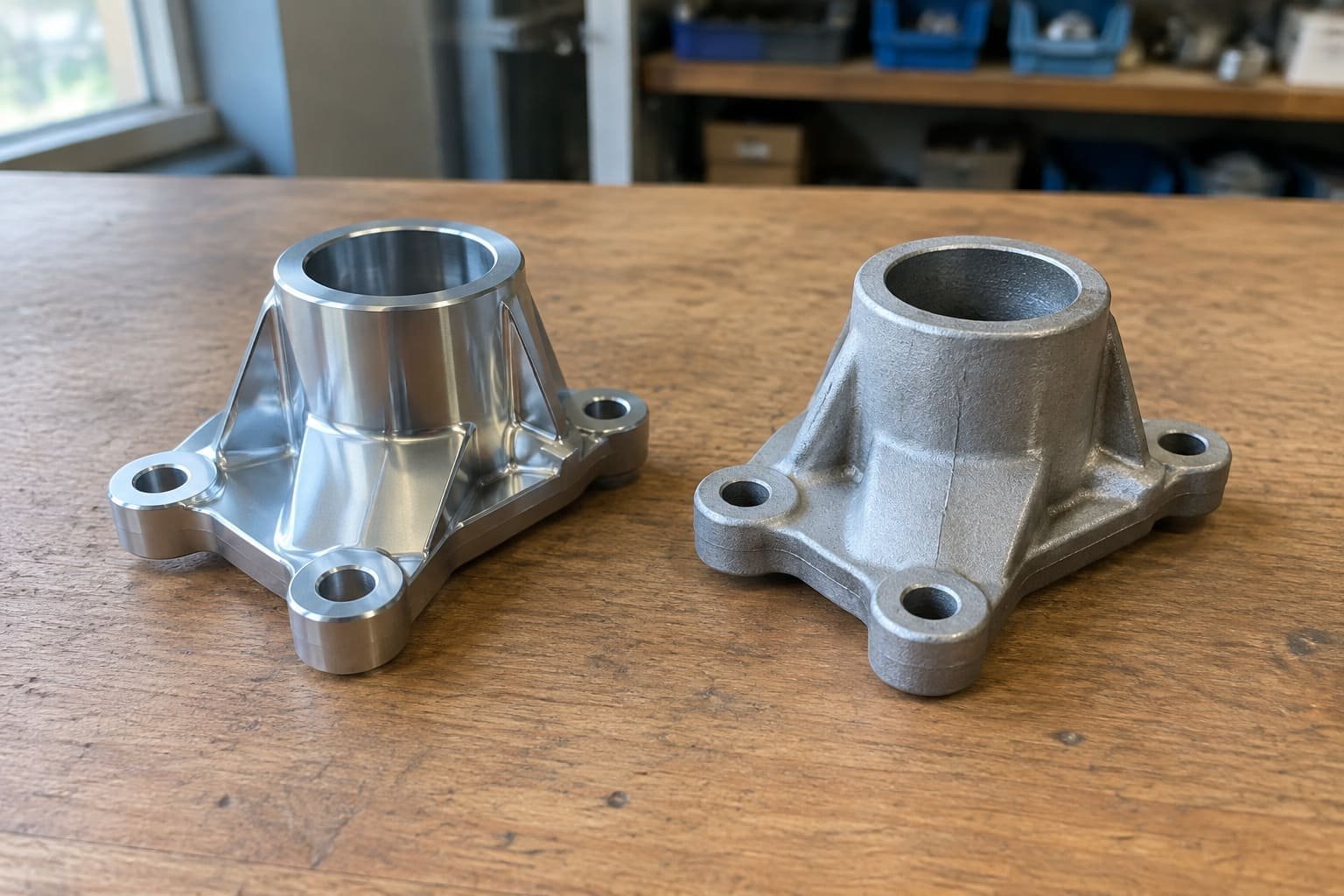
Are you trying to cast a part with complex internal channels, undercuts, or features that are impossible to form with a two-part mold? The geometry of your component is the first and most important filter in the decision between aluminum investment casting and die casting.
Investment casting is the superior choice for parts with highly complex internal geometries, thin walls, and features that require a "tool-less" cavity[3]. Because the process uses a sacrificial wax pattern, it can create intricate internal passages and undercuts without the need for slides or cores in a steel die. Die casting is better for simpler, high-volume parts where features like draft angles are acceptable.
Dive Deeper: Thinking Like a Foundry Engineer
When a drawing lands on my desk, the first thing I look for isn't the production quantity; it's the geometric complexity.
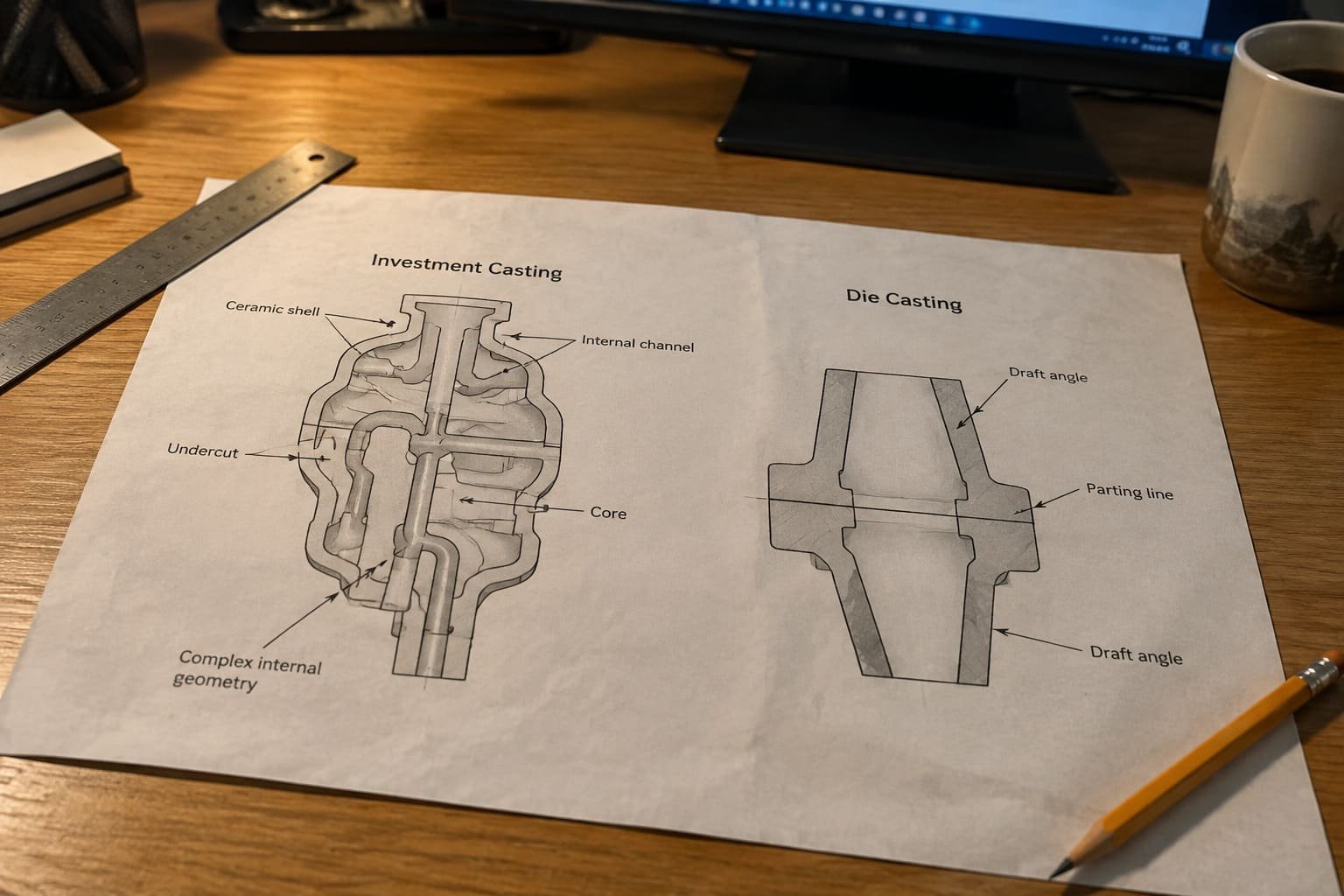
Investment Casting (Lost Wax Casting): The magic of investment casting is that we build a ceramic shell around a wax replica of your final part. This means we can create almost any shape imaginable, including:
- Internal Cavities and Channels: Think of a valve body with winding internal fluid passages. A solid steel tool could never form this. With investment casting, the wax pattern includes these passages, and the ceramic shell forms perfectly around it. When the wax is melted out, the internal geometry is left behind.
- Zero Draft Angles[4]: Die casting requires tapered sides (draft angles) so the part can be ejected from the steel mold. Investment casting doesn't need this, as the ceramic shell is simply broken away after casting. This is crucial for parts that must fit together with perfectly straight walls.
- Undercuts and "Impossible" Shapes: Features that would get trapped in a reusable mold are no problem for investment casting.
I recall a project for a medical device that had a tiny, serpentine channel running through the part for fluid delivery. Die casting was completely out of the question. The tooling would have been astronomically expensive and likely impossible to build. Investment casting was the only viable path forward.
Die Casting: This process is incredibly efficient but has its limitations. Since we're using a permanent, two-part steel die, the part must be designed for easy ejection. This means:
- Draft Angles are Mandatory[5]: All vertical faces need a slight taper, typically 1-3 degrees, to prevent the part from scraping against the mold as it's pushed out.
- No Trapped Features: The part must be able to pull cleanly away from the two halves of the die. Complex features can sometimes be achieved with hydraulic "slides" or "cores" that move into place before injection and pull away before ejection, but this adds significant cost and complexity to the tool.
- Parting Lines: A visible line will be present where the two halves of the die meet. While we can minimize its appearance, it's an inherent feature of the process.
For a recent project involving an A380 aluminum mounting bracket for an Australian solar company, die casting was the obvious choice. The design was straightforward, with simple ribs and mounting holes. The high annual volume meant the low unit cost of die casting would quickly offset the initial tooling investment.
When Do Tolerances and Surface Finish Decide the Process?
Are you designing a part that requires a mirror-like surface finish right out of the mold, or one that needs extremely tight, repeatable dimensions for automated assembly? Your requirements for precision and finish can quickly point you to the right process.
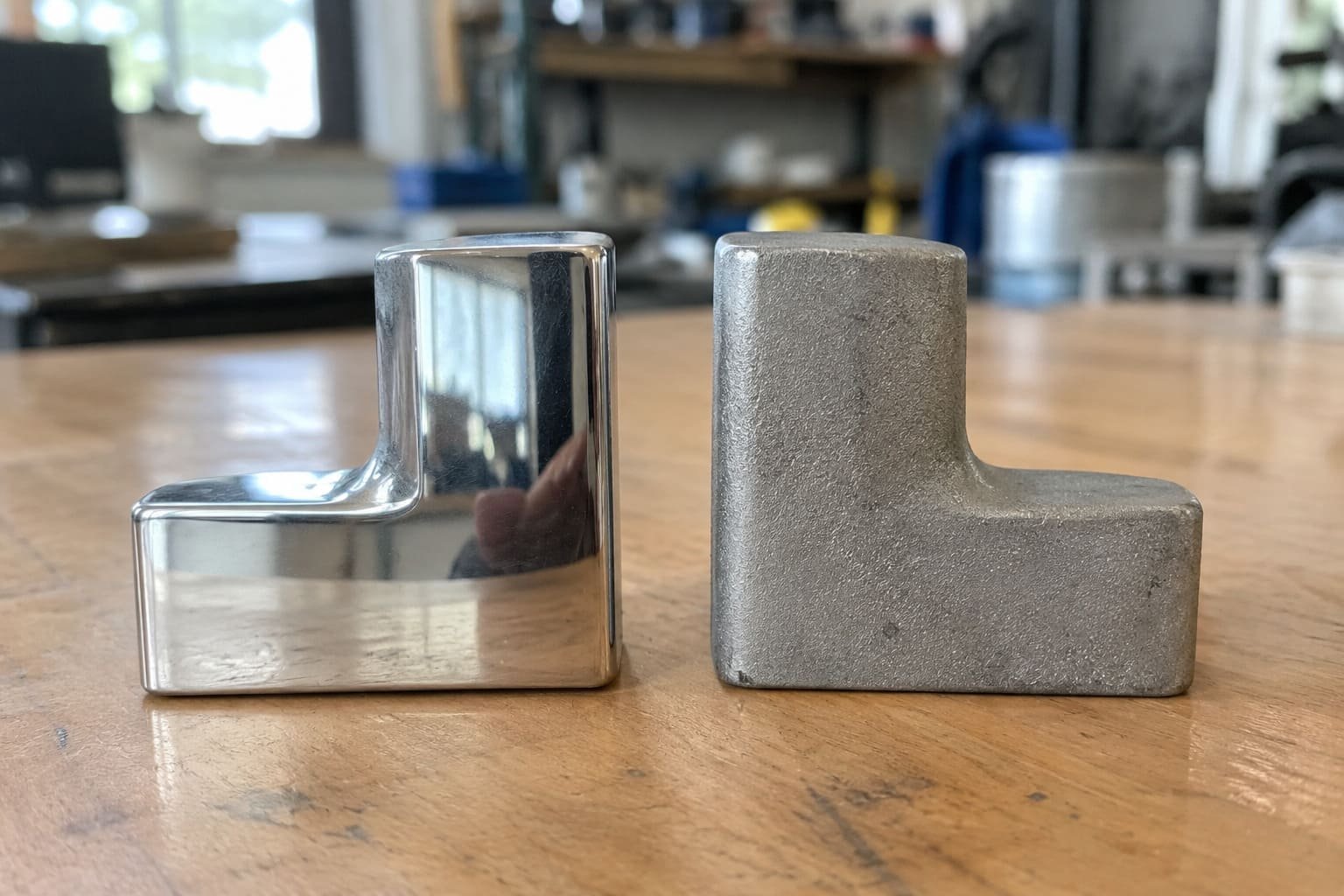
Investment casting generally achieves tighter as-cast dimensional tolerances, while die casting produces a smoother as-cast surface finish[6]. If holding a tolerance of ±0.05 mm is critical without secondary machining, investment casting has the edge. If you need a cosmetic finish with an Ra of 0.8–3.2 μm right from the tool, die casting is the winner.
Dive Deeper: Precision vs. Appearance
The choice here is a trade-off between the mold materials and the casting method itself.
Tolerances:
- Investment Casting: This process can hold very tight tolerances, often in the range of +/- 0.13 mm or better for smaller features. The ceramic shell is built directly onto the stable wax pattern, which provides a high degree of accuracy. However, because a new shell is created for every part, there can be slightly more part-to-part variation compared to die casting over a very long run.
- Die Casting: While standard die casting tolerances might be around ±0.1 mm to ±0.3 mm, the real strength of the process is its incredible repeatability. The hardened steel die is a stable, unchanging cavity. Once the process is dialed in, the 100,000th part will be virtually identical to the first. This is a huge advantage for high-volume production and automated assembly lines where consistency is key.
Surface Finish:
- Die Casting: The molten aluminum is injected against a highly polished, hardened steel surface, resulting in a very smooth as-cast finish (typically Ra 0.8–3.2 μm[7]). For many consumer products or housings, this finish is good enough to be used as-is or with minimal prep before painting or anodizing.
- Investment Casting: The finish of an investment cast part is a replica of the ceramic shell's inner surface. While we use fine ceramic materials, it still leaves a slightly more textured finish, typically Ra 1.6–6.3 μm. If a smooth cosmetic finish is required, a secondary operation like media blasting or polishing is almost always necessary.
A client once came to us with a design for a handheld electronics housing. The part required a beautiful, smooth finish for the consumer to hold. While the volume wasn't massive, the cosmetic requirement made aluminum die casting the right choice. The cost of polishing every single investment-cast part would have been far too high.
| Feature | Aluminum Investment Casting | Aluminum Die Casting |
|---|---|---|
| Typical Tolerance | ±0.05 mm to ±0.13 mm | ±0.1 mm to ±0.3 mm |
| Part-to-Part Repeatability | Good | Excellent |
| As-Cast Surface Finish (Ra) | 1.6 - 6.3 µm | 0.8 - 3.2 µm |
| Secondary Machining | Often needed for finish/tightest tolerances | Often minimized or eliminated |
Are Aluminum Alloys Interchangeable Between Processes?
Did you select an A356 aluminum alloy on your drawing because you saw it was good for casting? Be careful. The alloy you choose must be compatible with the manufacturing process, and performance properties are not directly transferable.
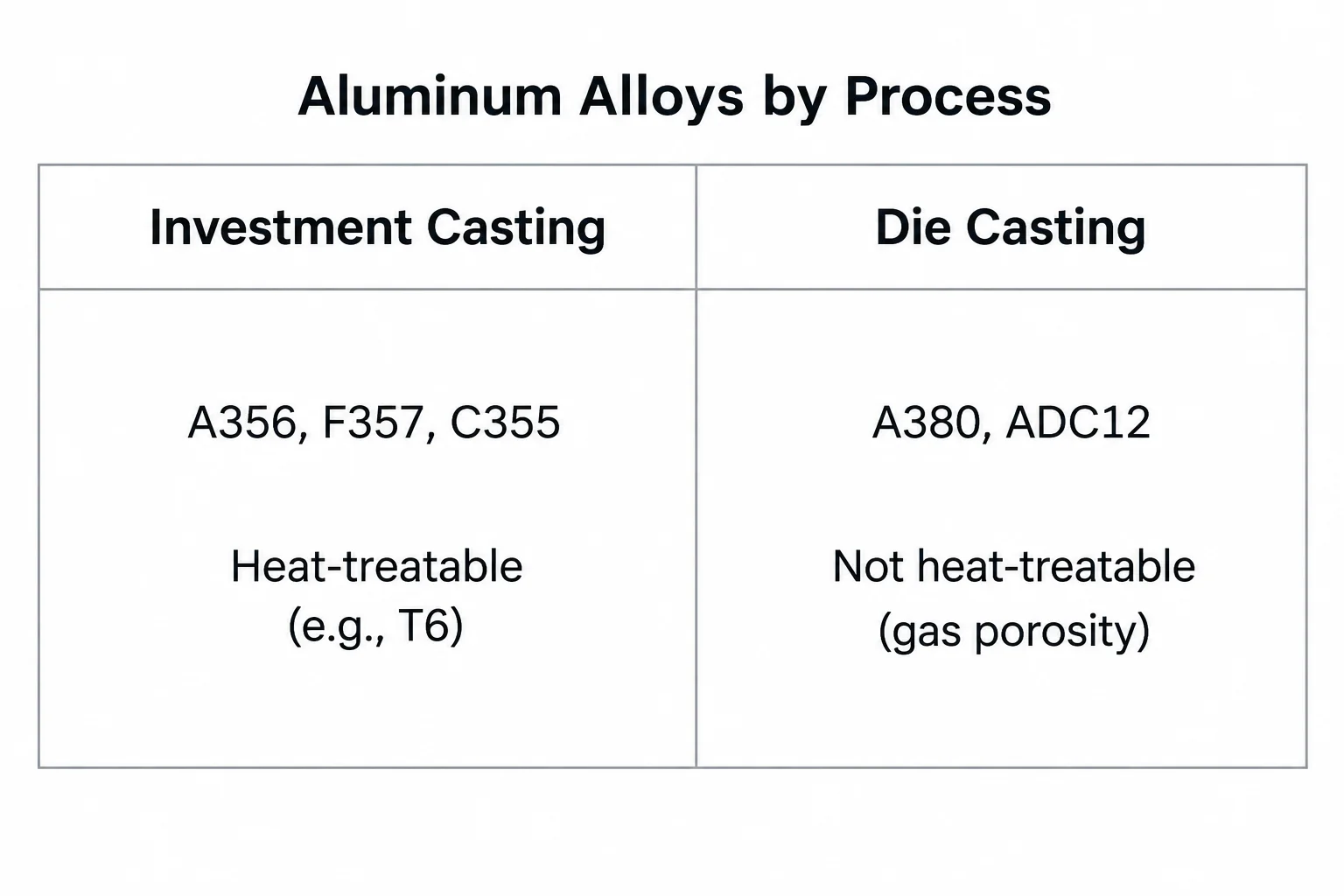
No, aluminum alloys are not interchangeable between investment casting and die casting. Investment casting typically uses alloys like A356, which are known for good strength and ductility and are heat-treatable. Die casting requires alloys with excellent fluidity and resistance to hot cracking under pressure, such as A380 or ADC12. Attempting to use an alloy designed for one process in the other will likely lead to poor results.
Dive Deeper: Material Science Matters
This is one of the most common mistakes I see from engineering teams. They specify an alloy without considering the physics of the casting process.
Investment Casting Alloys: These alloys are formulated for gravity or low-pressure pouring into a ceramic mold.
- Common Grades: A356, F357, and C355 are very common. A356, in particular, is a workhorse known for its excellent strength, ductility, and corrosion resistance[8].
- Heat Treatment: This is the key advantage. Alloys like A356 can be heat-treated (e.g., to a T6 condition) to significantly improve their mechanical properties. Investment-cast A356-T6 can achieve high strength with good elongation (5-12%), making it suitable for structural components that need to withstand stress without fracturing.
Die Casting Alloys: These alloys are designed to be injected at high speed and pressure into a steel die. Their chemistry is optimized for fluidity and to resist soldering to the die.
- Common Grades: A380 is the most popular die-casting alloy in North America, while ADC12 is its equivalent in Asia[9]. They offer a fantastic balance of cost, strength, and castability.
- Heat Treatment: Most standard die-cast parts cannot be properly heat-treated[10]. The high-speed injection process traps microscopic gas bubbles in the metal. If you try to heat the part in a furnace, this trapped gas expands and causes surface blisters, ruining the component. If you absolutely need high strength and ductility, investment casting is usually your only option.
We once reviewed an RFQ for a structural linkage for an agricultural machine. The drawing specified "A356-T6," but the requested volume was over 50,000 pieces per year, a quantity that screams "die casting." I had to explain to the customer that we couldn't die-cast A356-T6 and that the common die-casting alloy A380 wouldn't provide the ductility they needed. We ended up working with them to validate that an investment-cast A356-T6 part was the only way to meet their performance requirements, even though the unit price was higher.
How Does Production Volume Really Affect the Cost?
You've been told that die casting is for high volume and investment casting is for low volume. While generally true, this oversimplification can lead you to make the wrong choice. The real decision is about the total cost of ownership.
While die casting has a very high initial tooling cost ($10,000 - $100,000+) and a low per-part price, investment casting has a much lower tooling cost but a higher per-part price. The "break-even" point where die casting becomes more economical is not a fixed number; it can range from 5,000 to 15,000 parts depending on part complexity, machining costs, and finish requirements.
Dive Deeper: The Break-Even Calculation
The decision to invest in a hardened steel die is a major financial commitment. Let's break down why.
-
Tooling Costs:
-
Investment Casting: The "tool" is a relatively simple aluminum mold used to create the wax patterns. It doesn't have to withstand high pressure or temperature, so it's much cheaper to make.
-
Die Casting: The tool is a massive block of hardened H13 tool steel, precision-machined with cavities, ejector pins, cooling lines, and potentially complex slide mechanisms. This is a significant upfront investment.
-
Unit Costs:
-
Investment Casting: The process is labor-intensive. Each part requires a new wax pattern to be injected, assembled onto a "tree," dipped in ceramic slurry multiple times, de-waxed, cast, and then broken out of the shell. This results in a higher cost for each individual part.
-
Die Casting: Once the machine is running, it's highly automated. Parts can be produced every 30-90 seconds with minimal labor, driving the per-part cost way down.
Finding the Crossover Point: Imagine a project with a 50,000-part annual demand.
- Investment Casting: Might have a $5,000 tooling cost and a $15 unit price. Total first-year cost: $5,000 + (50,000 * $15) = $755,000.
- Die Casting: Might have a $60,000 tooling cost but a $4 unit price. Total first-year cost: $60,000 + (50,000 * $4) = $260,000.
In this scenario, the savings from die casting are massive. However, if the annual demand was only 2,000 parts:
- Investment Casting: $5,000 + (2,000 * $15) = $35,000.
- Die Casting: $60,000 + (2,000 * $4) = $68,000.
Here, investment casting is the clear financial winner. The key is to run this analysis with real quotes for your specific part. A very complex part might have such an expensive die-cast tool that investment casting remains cheaper even at higher volumes. Conversely, a simple part that requires extensive post-machining after investment casting might be cheaper to die-cast to a near-net shape.
Frequently Asked Questions
What's the main difference in tooling between die casting and investment casting?
Die casting uses a permanent, reusable mold made from hardened tool steel that can cost tens of thousands of dollars but can produce hundreds of thousands of parts. Investment casting uses a less expensive aluminum tool to create disposable wax patterns; the actual casting mold is a ceramic shell that is destroyed for each casting cycle.
Can I convert a die-cast part to an investment-cast part?
Yes, this is often possible, especially if you need to switch to a material like stainless steel or require a design feature (like an internal channel) that die casting can't produce. However, you will likely need to remove die-casting-specific features like draft angles and adjust your cost expectations, as the unit price will be higher.
What information do I need for a reliable quote for aluminum investment casting or die casting?
To get a truly comparable quote from suppliers, you must provide a complete technical package. This includes 2D drawings with tolerances, a 3D CAD model, the specified aluminum alloy (or performance requirements), annual and batch quantity expectations, critical surface finish requirements, and any post-processing needs like machining or coating.
Conclusion
Choosing between aluminum investment casting vs. die casting is a critical engineering and procurement decision that goes far beyond a simple volume threshold. The best choice is always part-specific. You must start by evaluating your design's geometry, required tolerances, and performance needs. Only then can you accurately weigh the economic trade-offs between tooling investment and per-part cost. Don't assume an alloy is interchangeable, and always factor in the cost of necessary secondary operations like machining or polishing.
By asking these questions upfront, you can avoid costly mistakes and select the process that delivers the best total value for your project. If you have a drawing for a custom aluminum component and are unsure which path to take, our team can help.
Send us your 2D/3D files, material requirements, and volume expectations. We'll provide a technical review and a transparent quote to help you make an informed decision.
Sources & references
Reference note
Standard manufacturing references define die casting as the pressure injection of molten metal into a reusable metal die; this definition supports the process description but does not by itself establish the article's claims about production volume or surface finish. Evidence role: definition; source type: encyclopedia. Supports: The source should define die casting as the injection of molten metal under pressure into a reusable die, including its application to aluminum.. Scope note: A general process definition does not prove that die casting is optimal for every high-volume aluminum component.
Reference note
Technical literature on investment casting describes a wax pattern enclosed in a ceramic shell, followed by wax removal and shell break-out after metal solidification; this supports the stated mechanism without demonstrating that every geometry is feasible. Evidence role: mechanism; source type: research. Supports: The source should document wax-pattern production, ceramic-shell formation, wax removal, and destruction of the shell after casting.. Scope note: The mechanism supports design flexibility in principle, but specific internal passages may still require cores, inserts, or post-casting operations.
Reference note
Comparative casting studies report that sacrificial-pattern investment casting can accommodate geometries and undercuts that may require moving die components or additional cores in pressure die casting; this supports a relative capability advantage, not a universal superiority claim. Evidence role: general_support; source type: paper. Supports: The source should compare investment casting and die casting with respect to undercuts, internal passages, thin sections, and tooling constraints.. Scope note: Feasibility depends on alloy, wall thickness, shell design, pattern manufacture, and required internal-surface quality.
Reference note
Investment-casting design guidance indicates that the sacrificial shell avoids the mechanical ejection constraint associated with a permanent die, allowing some nominally undrafted or undercut features; this does not mean that draft is never useful for wax-pattern production or shell integrity. Evidence role: mechanism; source type: education. Supports: The source should explain why a sacrificial ceramic shell does not require the same ejection draft as a permanent two-part die.. Scope note: The phrase “zero draft” should be qualified because process-specific pattern and shell requirements can impose geometric restrictions.
Reference note
Die-casting design references identify draft as a release feature that reduces friction and damage during ejection and commonly give values in the low-degree range for aluminum parts; the exact value is design-specific rather than universally fixed at 1–3 degrees. Evidence role: general_support; source type: education. Supports: The source should explain the need for draft to release castings from dies and provide industry or engineering ranges for aluminum die-cast features.. Scope note: Some local features may use different draft values, and specialized die actions can alter the requirement.
Reference note
Comparative manufacturing literature generally associates pressure die casting with smooth mold-replicated surfaces and investment casting with competitive dimensional accuracy for appropriately sized features; the relative ranking varies with part size, alloy, tooling, and post-processing. Evidence role: general_support; source type: paper. Supports: The source should compare typical dimensional tolerance and surface-roughness outcomes for investment and aluminum die casting.. Scope note: Typical process ranges cannot validate the article's exact tolerance and roughness values for an unspecified component.
Reference note
Studies of aluminum pressure die casting report relatively low as-cast surface roughness under suitable die and process conditions, with values in the micrometre range; this supports the order of magnitude but not the quoted range for every die-cast surface. Evidence role: statistic; source type: research. Supports: The source should report measured or standardized roughness ranges for as-cast aluminum die-cast surfaces.. Scope note: Surface roughness is location- and process-dependent, so a single Ra interval should not be treated as a universal specification.
Reference note
Materials references characterize A356 as a commonly used aluminum-silicon-magnesium casting alloy whose heat-treated condition can provide a useful balance of strength and elongation; corrosion performance and mechanical values depend on temper, porosity, and processing. Evidence role: general_support; source type: research. Supports: The source should document A356's typical composition, castability, tensile properties, elongation, and corrosion-related performance.. Scope note: Alloy designation alone does not establish the properties of a particular investment-cast part.
Reference note
Alloy-comparison references identify A380 and ADC12 as widely used aluminum-silicon-copper die-casting grades with broadly similar application profiles, but their specifications are not necessarily identical and regional popularity requires separate evidence. Evidence role: general_support; source type: institution. Supports: The source should compare A380 and ADC12 compositions and explain the regional standards or usage patterns associated with each designation.. Scope note: Chemical similarity does not establish interchangeability for a specific product, specification, or qualification program.
Reference note
Research on conventional high-pressure aluminum die casting links entrapped gas and shrinkage porosity to blistering or dimensional defects during elevated-temperature heat treatment, while also documenting specialized processes that can reduce the problem. Evidence role: mechanism; source type: paper. Supports: The source should explain the relationship between high-pressure die-casting porosity, solution treatment, gas expansion, and blister formation.. Scope note: The evidence does not support the absolute claim that every die-cast aluminum alloy or every die-casting process is non-heat-treatable.