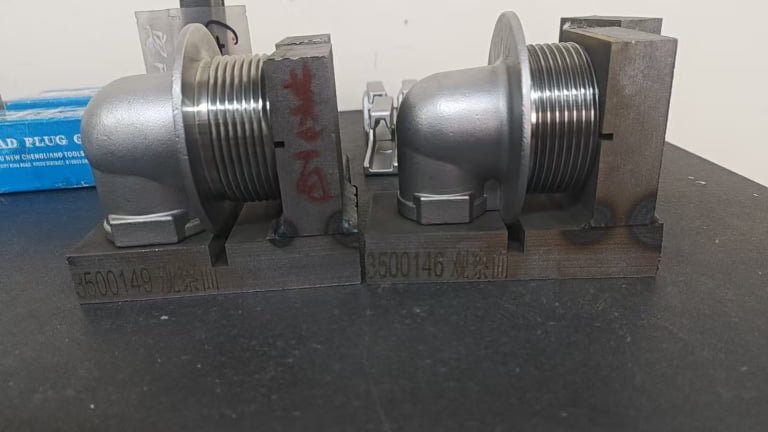
A useful custom metal parts RFQ does not need to be long, but it must separate confirmed requirements from open questions. At minimum, provide a controlled drawing or model, material requirement, expected quantity, application, critical features and the records needed for acceptance. This gives engineering and sales teams enough context to review feasibility, identify assumptions and prepare a quotation with a defined scope.
Start with the minimum quotation package
The fastest way to reduce quotation gaps is to submit one controlled package rather than distributing requirements across several emails. The package should identify the part, the latest revision and the commercial quantity being reviewed.
| RFQ input | Why it matters | Acceptable starting point |
|---|---|---|
| 2D drawing and/or 3D model | Defines geometry, interfaces and controlled dimensions | PDF drawing plus STEP, STP, IGES or another agreed neutral model |
| Material | Affects process route, tooling, machining, treatment and inspection | Grade and governing specification, or a clearly marked request for an alternative |
| Quantity | Changes tooling economics, cycle planning and inspection strategy | Prototype quantity, first order quantity and expected repeat or annual demand |
| Application | Helps identify functional and environmental risks | Component function, operating environment and critical failure concerns |
| Acceptance requirements | Defines what must be inspected, tested and documented | Critical dimensions, sampling, material records, tests and report format |
| Delivery target | Allows tooling, sampling and production stages to be planned | Required sample date and production delivery window |
Use the 3D model and 2D drawing for different jobs
A 3D model is useful for understanding overall geometry, complex surfaces, draft, wall transitions, machining access and tooling concepts. A 2D drawing remains important when it controls dimensions, tolerances, datums, surface finish, material notes, heat treatment, coating, inspection or other acceptance requirements.
If the model and drawing do not represent the same revision, the supplier should not be expected to choose which file is authoritative. State the controlling document and revision in the RFQ. When only a physical sample is available, identify which dimensions and functions must be reproduced and which features may be reviewed or redesigned.
Define material beyond a familiar grade name
A grade designation alone may not fully define product form, condition, heat treatment or governing specification. The same family name can be used differently across ASTM, AISI, SAE, EN, JIS and GB systems. State the required standard and delivery condition when they are controlled by the project.
If an equivalent or alternative grade may be considered, say so explicitly and define the basis for approval. The comparison may need to cover chemistry, mechanical requirements, corrosion behavior, heat treatment, weldability, machinability, product form and required certification. Similar numeric names should not be treated as automatic equivalents.
Separate critical tolerances from general tolerances
Applying a tight tolerance to every feature can increase tooling, machining and inspection cost without improving function. Mark the interfaces that actually control assembly, sealing, alignment, motion, load transfer or appearance. Identify the datum structure and state whether a requirement applies to the as-cast, forged, machined, treated or finished condition.
For critical features, include the numerical requirement, measurement basis and acceptance method. If the tolerance strategy is not final, list the functional requirement and ask for a manufacturability review before the drawing is released for tooling.
Provide quantity at more than one stage
One quantity number may not be enough. A supplier may need to distinguish prototypes, tooling samples, pilot production, the first commercial order and expected repeat demand. These stages affect process selection, tool concept, fixture planning, material purchasing, inspection frequency and unit-price assumptions.
A forecast does not have to be a binding commitment. Label it as an estimate and explain expected order frequency or demand range. This is more useful than requesting one price without stating whether the project is a one-time requirement or a repeat-production program.
State secondary operations and the finished condition
Custom parts often require more than the primary forming process. Machining, deburring, grinding, heat treatment, welding, assembly, coating, plating, passivation, polishing, cleaning and marking may affect dimensions and final acceptance. Identify which operations must be included in the quotation and which will be completed by the customer or another supplier.
Where a finish is controlled, provide the specification, color or appearance reference, masking requirements, surface preparation, thickness requirement when applicable, and the surfaces that must remain free from treatment. Avoid relying on a generic finish name when the final condition is important to assembly or service.
Define inspection, documentation and traceability
Inspection scope should follow the drawing, project risk and agreed quality plan. The RFQ should identify critical characteristics, sampling expectations, required tests and the records that must accompany samples or production shipments.
- Material certificate or other agreed material verification
- Dimensional report for selected drawing characteristics
- First-article or sample inspection package when required
- Heat-treatment, coating or external-process records when included
- Pressure, leakage, NDT or functional testing only when specified
- Batch, heat, lot or other traceability information appropriate to the project
Do not assume every test, report or accreditation is included in a standard quotation. Ask the supplier to identify included records, outsourced activities, exclusions and additional cost before the order is released.
Control revisions and open questions
Give every RFQ package a visible revision or date. If requirements change during quotation, send a consolidated update and identify what changed. The final quotation should reference the drawing revision, material basis, quantity, included operations, inspection scope, tooling assumptions and delivery terms used for pricing.
Open questions are normal during early sourcing. Record them in an assumption list rather than allowing them to remain in separate messages. Each item should show who must respond and whether the answer affects price, tooling, lead time, quality or manufacturability.
Review the quotation as a scope document
The lowest unit price is not necessarily the lowest total purchasing cost if the quotations do not cover the same material, tooling, operations, inspection, packaging and delivery basis. Compare proposals line by line and resolve exclusions before approving tooling or samples.
A complete quotation should make clear what is included, what is excluded, what remains to be confirmed and which drawing revision controls the work.
What happens after the RFQ is submitted
The engineering review should confirm whether the proposed manufacturing route is suitable for the geometry, material, quantity and acceptance requirements. Any recommended drawing changes, alternative processes or unresolved assumptions should be documented before quotation approval.
After commercial approval, the project can move through tooling or fixture planning, sample manufacture, inspection, corrective actions and customer approval. Repeat production should be released only against the agreed revision and acceptance basis.