Skip to content

ANONYMIZED PROJECT CASE

304 Stainless Investment-Cast Turbo Exhaust Manifold for North America

A North American automotive aftermarket customer moved a 304 stainless turbo exhaust manifold through DFM review, investment-casting development, material and dimensional checks, installation validation and repeat supply.

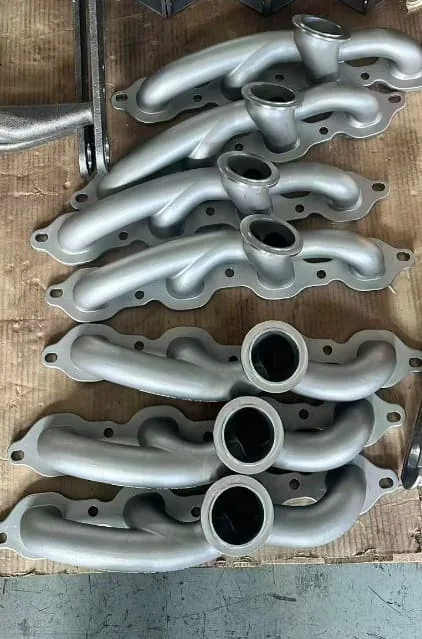
Finished 304 stainless investment-cast turbo exhaust manifolds arranged as a batch
Part
304 Stainless Turbo Exhaust Manifold
Material
304 stainless steel under the approved project material specification.
Primary Process
Investment Casting
Project Stage
Repeat Production
Region
North America

PART & APPLICATION

What the component needed to do.

The manifold is used on the exhaust side of a performance turbocharger system for GM LS-platform applications. Integrated passages, flange interfaces, mounting locations and elevated-temperature service requirements had to be reviewed together rather than as isolated casting features.

Anonymized customer case. Customer name, personal contacts, exact quantities, pricing, internal cost, drawings, dimensions, test parameters and controlled reports are withheld. Vehicle examples are described only at the platform level supplied in the source workbook.

PROJECT REQUIREMENT

What had to be confirmed.

The customer needed a small-batch 304 stainless exhaust manifold with integrated passages, controlled wall transitions, flat and aligned flange interfaces and stable mounting geometry. The project also required material documentation and a practical route for dimensional and surface verification.

Exact quantities, service temperature, controlled dimensions, tolerances and acceptance limits are withheld.

MANUFACTURING CHALLENGE

What required engineering attention.

The manifold combined multiple curved exhaust passages and mounting interfaces in one casting. The route needed to address wax-pattern and shell accessibility, filling and feeding of connected passages, wall consistency, distortion risk and access for finishing and inspection.

The customer was also evaluating durability under its own exhaust-system conditions. Material suitability and performance therefore remained application- and test-specific; the public case does not claim that 304 stainless steel is automatically suitable for every turbocharger temperature or duty cycle.

MANUFACTURING ROUTE

How the component moved through production.

The primary process and supporting operations are shown as one connected route.

The engineering route combined drawing review and DFM feedback with investment casting of the integrated manifold geometry. Review focused on passage continuity, wall transitions, flange and mounting interfaces, wax and shell handling, casting fill and feeding, distortion control and access for finishing.

Blasting provided the specified external surface condition. Material confirmation, dimensional inspection and customer installation testing were completed before repeat supply. Final suitability remained tied to the customer’s released design and application validation.

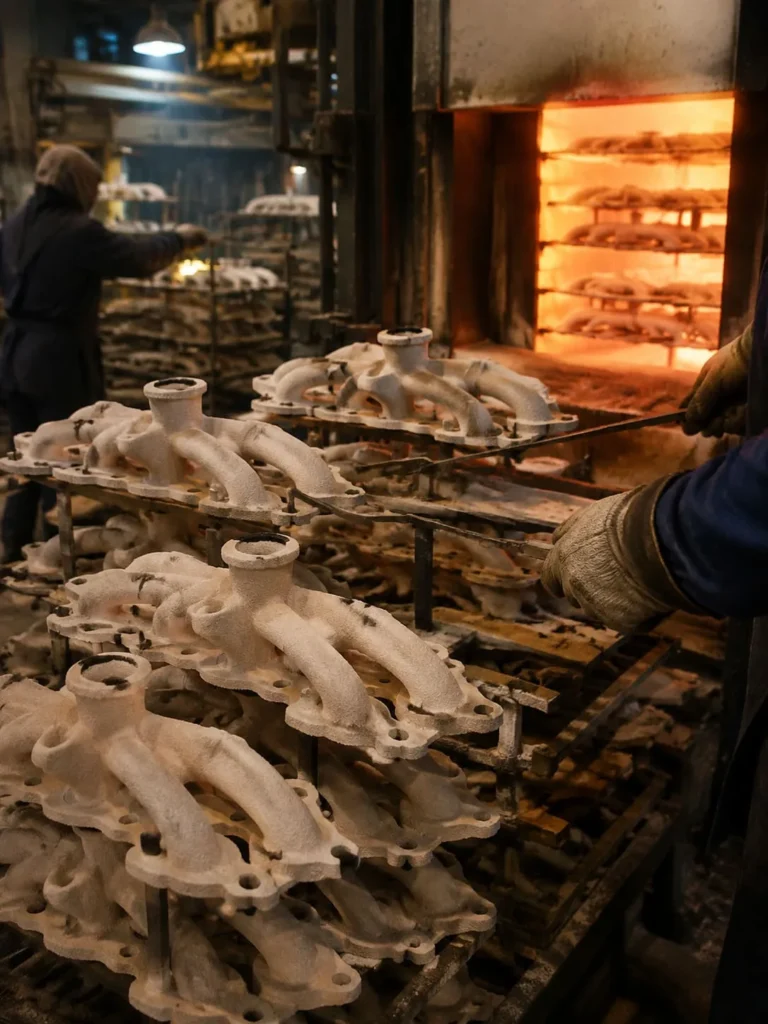
Investment-cast turbo exhaust manifolds shown during a hot production stage
Production-stage image supplied with the anonymized case materials.

Drawing & Requirement Review

Part function, controlled dimensions and acceptance needs.

Investment Casting

Lost-wax investment casting for complex steel components requiring detailed geometry, repeat production and coordinated machining, finishing and inspection.

Abrasive Blasting

The cast manifold received a uniform blasted external finish as part of the approved production route.

Flange and Interface Finishing

Flange faces and mounting interfaces were finished and verified to the controlled drawing requirements.

Inspection & Release

Evidence checked against the agreed project scope.

TOOLING & SAMPLE APPROVAL

How the project moved toward repeatable production.

The recorded route progressed through drawing review, DFM feedback, first-sample casting, dimensional and material checks, customer installation testing and application-specific elevated-temperature validation before batch release.

The workbook records a three-to-six-month inquiry-to-order cycle including sample validation. Estimated future lead times are not published as guaranteed delivery commitments.

QUALITY & VERIFICATION

Evidence tied to the agreed requirement.

The project plan included dimensional verification of the flange and mounting interfaces, material spectrometry, visual inspection and hardness review where required by the released route. Material documentation and a first-article dimensional report were used during customer validation.

Exact tolerances, test temperatures, cycles and acceptance limits remain confidential. Future parts require drawing- and application-specific review.

Material verification

The production route included material spectrometry and material documentation for the specified 304 stainless grade.

Outcome: Material identity was included in the sample and batch validation record.

First-article dimensional review

Flange, mounting and interface characteristics were checked against the released drawing during sample validation.

Outcome: The customer proceeded to installation testing after the recorded dimensional review.

Customer installation validation

The customer evaluated the manifold in its own installation and elevated-temperature duty before repeat ordering.

Outcome: The workbook records acceptance with no cracking or deformation reported during the stated customer validation, followed by repeat supply.

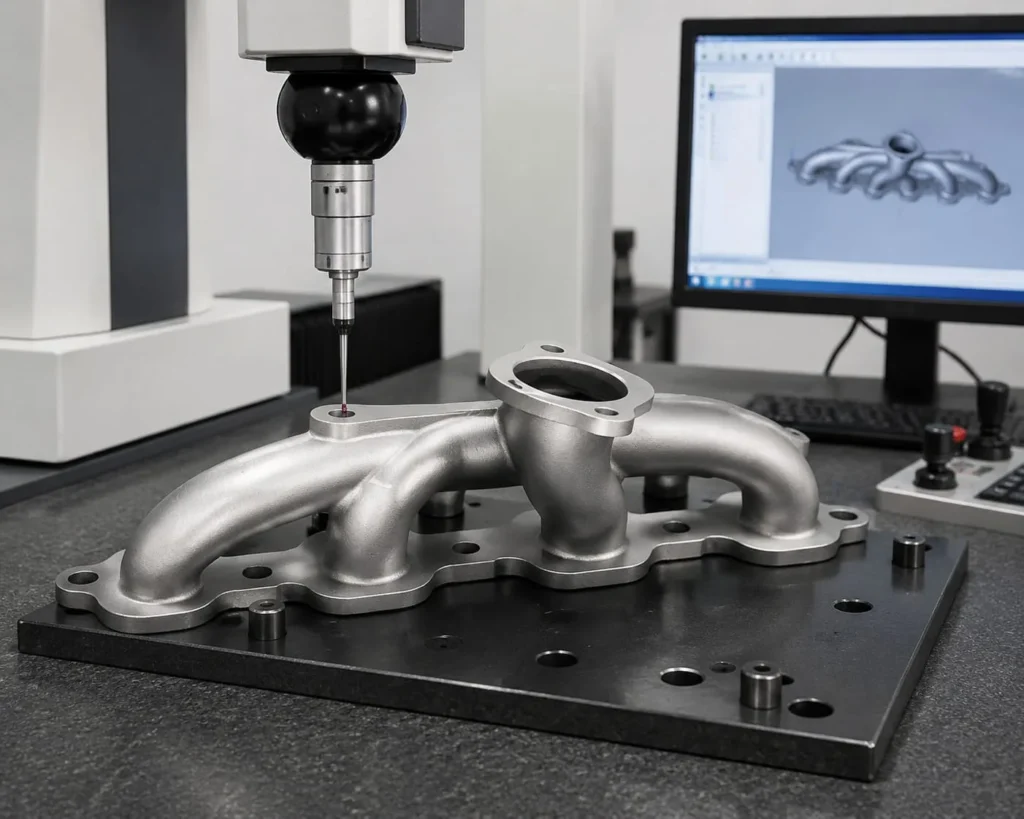
Turbo exhaust manifold positioned for dimensional inspection
Inspection-stage image supplied with the case; the controlled report and dimensions remain private.

PROJECT RESULT

What was confirmed for the project.

The workbook records successful batch supply, customer installation validation and continuing repeat orders. No cracking or deformation was reported during the customer’s stated validation scope.

Yield, on-time and repurchase percentages from the worksheet are intentionally not published because no approved supporting records were supplied. The result should be read as one project outcome, not a universal performance guarantee.

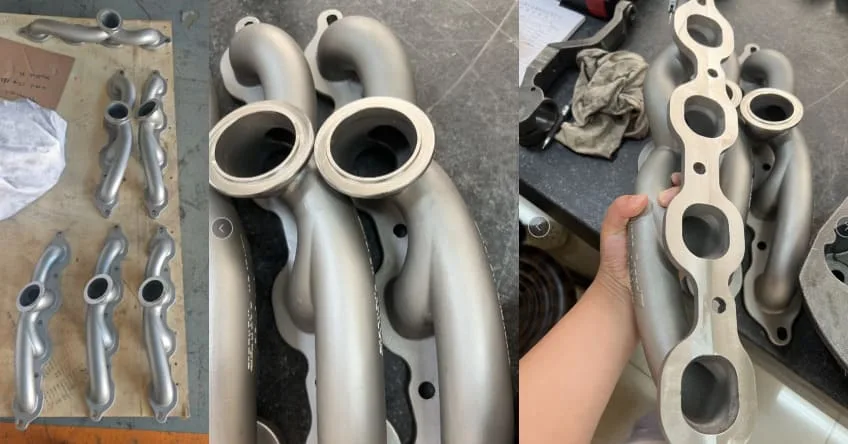
Multiple views of 304 stainless turbo manifolds showing integrated passages and finished flange interfaces
Integrated flow passages and finished interfaces shown without controlled dimensions.

CONNECTED CAPABILITIES

Continue by process, application or material.

Supporting Operations

Abrasive BlastingFlange and Interface Finishing

RELATED PROJECT RECORDS

Cases with connected manufacturing context.

ENGINEERING REVIEW

Have a similar component ready for review?

Share the drawing or sample, material, quantity, application and acceptance requirements. Our team will review the feasible route before quotation.